Contents
Key Summary
2026-07-17 Current view: OGM is a real, useful technology. In clinical cytogenetics, especially blood cancers, it is better than a karyotype plus FISH, and the evidence and payment are gradually falling into place. But its advantage rests on sequencing being not long enough, not cheap enough and not deep enough, and long-read sequencing and Illumina's new technology are slowly taking that premise away. In assembly I watched it go from required to optional with my own eyes, and I think the same thing will happen again in cytogenetics, more slowly. At the company level, revenue is stuck at ~$29M, R&D has been cut to ~$12M a year, cash only lasts into early 2027, and dilution will continue. The technology will most likely survive, whether in Bionano's own hands or folded into a larger company; but as an independent company it faces a great deal of uncertainty. No position at the moment.
2026-07-17 Technology route: The essence of optical mapping is trading very low information density (one dot every ~6kb) for a very long span and a very low cost. It does not read bases, but it sees the structure across 250kb at once, for about $500 of consumables per sample. For large structural variants, balanced translocations and low-frequency somatic variants, it is still more direct and cheaper than sequencing today. But that advantage rests on sequencing being "not long enough, not cheap enough, not deep enough", and sequencing is improving fast on all three.
2026-07-17 Market view: The company estimates OGM's potential market at $10.0B a year: ~10K cytogenetics labs worldwide running ~10.0M samples a year. But almost eight years after listing, and more than a decade after full commercialization, revenue is only $28.74M TTM. I think the market it can actually capture is clinical cytogenetics, led by blood cancers, plus quality control for cell and gene therapy. That is a real market with real payment, but it is a "window" market: until sequencing can see SNVs and SVs together, cheaply and deeply enough, OGM is the best tool for replacing the karyotype; once sequencing gets there, labs are more likely to skip OGM entirely. My guess is this window has 5-10 years left.
2026-07-17 Competitive landscape:
| Method | What it sees | Main weakness |
|---|---|---|
| Karyotyping, G-banding | Whole genome at ~5-10Mb resolution, balanced translocations | Needs cell culture, slow, low resolution, manual |
| FISH | Known target loci | Only sees the probes designed in advance |
| CMA array | Genome-wide CNVs | Cannot see balanced translocations or inversions |
| Short-read WGS (Illumina) | SNVs, CNVs, some SVs | Weak in repeats and on balanced events |
| Long-read WGS (PacBio, ONT) | SNVs, SVs, methylation, phasing | High depth is still expensive |
| Proximity mapped reads (Illumina) | Long-range information on top of short reads | Just starting commercially, little clinical evidence |
| OGM (Bionano) | All SVs above 500bp, low-frequency somatic SVs | Does not read bases, strict sample requirements |
| EGM (Nabsys, Hitachi) | Reads structure electronically | Few placements and little evidence |
2026-07-17 Data Analysis:
| Ticker | BNGO | |
| Data As Of | 2026-07-17 | |
| Share Price | 1.15 | |
| Shares Outstanding | 11.48 M | # As of 2026-05-06. Plus ~12.1M warrants (2026-03-31). |
| Market Cap | 13.2 M | # The market cap is down to loose change. |
| Revenue | 28.74 M | # TTM, 2025-Q2 to 2026-Q1. |
| Gross Margin | 48.6% | # 2026-Q1. |
| Earning | -31.59 M | |
| PS | 0.46 | |
| PE | -0.42 | |
| Cash | 14.4 M | # Cash plus short-term investments at 2026-03-31. Another 10.3M of restricted funds went to pay off the convertible debentures on 2026-05-26. |
| FCF (-SBC) | -22.9 M | |
| Cash Runway | 0.63 | # The company's own line is that it lasts into 2027-Q1. |
| Dilution 3Y | 2144% | # 2023-05 to 2026-05, split-adjusted. |
| Dilution 1Y | 241.1% | |
| Installed Base | 387 | # 2025-12-31. |
| Flowcells 2025 | 30,171 | # ~78 samples per instrument per year on average. |
Complete Notes
Personal Experience
Personal experience: During my PhD we assembled a rat reference genome, and we used Bionano's optical mapping to do it. We worked with the company itself on the technical side and also ran samples through a service provider; I will leave the details out here. We used DLS, Direct Label and Stain: very long DNA molecules get a fluorescent dot at one fixed 6bp motif, are straightened out and photographed, and each molecule turns into a string of dots. The spacing between dots gives a rough guess of how many bases sit between two motifs. Line that spacing up against the contigs from sequencing, and you can put the contigs in order, orient them, estimate the size of the gaps between them, and catch the places where the assembly joined things wrongly. That is Bionano's core use in assembly.
- So my feel for this technology is very concrete: it does not read bases, but it sees a very long stretch at once, and back then it gave an assembly an almost independent piece of "physical evidence". That was very valuable in 2017-2019, when sequencing reads were not yet long enough.
- The rat reference genome I worked on became mRatBN7.2 (Sanger, Vertebrate Genomes Project), which the Genome Reference Consortium adopted as the new standard rat reference genome in 2020. It was built on the full combination of PacBio CLR + 10x linked reads + Bionano DLS + Hi-C. The three companies in that combination are exactly the three reports in this series: Bionano, PacBio, 10x Genomics.
- Having used it, I also saw more clearly how it was later replaced in assembly. That is one of the core questions this report sets out to answer.
Company History
Before the IPO:
- 2003: Han Cao spun BioNanomatrix out of nanochannel research at Princeton. The technology came from a DARPA-funded project and is exclusively licensed from Princeton. The core idea is to use nanochannels on a silicon chip to straighten out a very long piece of DNA.
- 2011: renamed BioNano Genomics, with Erik Holmlin as CEO, a job he would hold for 15 years. Al Luderer joined the board the same year. The company later settled in San Diego.
- 2012: Lam et al. published the nanochannel genome mapping method in Nature Biotechnology, and the first-generation instrument, Irys, came out the same year.
- 2017: the second-generation instrument, Saphyr, launched, followed by DLS direct labeling. Together these two lifted both map quality and throughput a level, and that is when assembly projects of my generation started using it.
- At this stage the customers were basically research institutions, and the main uses were de novo assembly and structural variant research. 2017 revenue was $9.51M, with a loss of $23.37M.
IPO: Listed on Nasdaq on 2018-08-21, selling 3.864M units at $6.125 each, one share plus one warrant per unit, for net proceeds of only $19.4M. The deal size was cut again and again before pricing, and it took warrants thrown in to get it sold. A small IPO that needs free warrants to clear tells you institutions had very little interest at the time.
After the IPO:
- 2019: revenue fell from $12.0M to $10.13M and the loss widened to $29.82M. The share price slid from ~$5 to ~$1, kept going by small share sales.
- 2020: hit a low of $0.25 in April. In August it bought Lineagen, a clinical lab testing for autism and developmental delay, its first step into clinical services. Retail hype started at the end of the year.
- 2021-01: the share price ran from ~$0.50 in early December to $5-$12. The company grabbed the window and closed two underwritten offerings that month, $101.8M at $3.05 and $230M at $6.00, which with the ATM raised about $349M in one month. It closed at $15.57 on 2021-02-16, the highest since the listing. To be fair, this round of fundraising was the best thing management ever did.
- 2021-10: bought BioDiscovery for about $100M in cash and stock, getting the NxClinical cytogenetics analysis software, which later became VIA.
- 2022-11: bought Purigen, a company that extracts DNA with isotachophoresis (ITP), for $32M up front plus up to $32M in milestone payments. The step it was meant to fix is getting ultra-long DNA out.
- 2023: revenue peaked at $36.12M. So did the loss, at -$232.49M, including a $77.3M goodwill impairment. A 1:10 reverse split in 2023-08, and restructuring with layoffs in May and October.
- 2024: the high-throughput Stratys instrument reached full commercial release in January. Two more restructurings in March and September cut about 120 and 83 people, and Lineagen's non-OGM testing was shut down. Purigen's and Lineagen's intangible assets were fully impaired. In May it issued $20M face of secured convertible debentures to JGB to redeem the earlier High Trail note at 115%. In June the AMA approved the first Category I CPT code for OGM in blood cancers, 81195.
- 2025: a 1:60 reverse split in January, and in the same month a $10M direct offering at $15.12 (split-adjusted) with warrants attached. In September another $10M offering at $2.00, with an E and an F warrant per share. The AMA approved a second CPT code, 81354, for OGM in genetic disease. Bionano Laboratories also shut down its own blood cancer and genetic disease LDTs this year, keeping only FSHD1.
- 2026: from January the Medicare payment for 81195 rose from $1,263.53 to $1,853.22, up 47%. On 2026-05-05 Holmlin stepped down as CEO and chairman Al Luderer became interim CEO. On 2026-05-26, the maturity date, it paid off all the convertible debentures. On 2026-06-02 chief medical officer Alka Chaubey resigned. On 2026-06-24 it named Alex Hastie chief scientific officer from July 20; he was the second author of that 2012 Nature Biotechnology paper.
Share price: Split-adjusted, it fell 99.97% from the IPO to 2026-07-17, and 99.99% from the 2021 high. There were two reverse splits along the way, 1:600 in total. The $6.125 IPO price is worth $3,675 in today's share count; the price now is $1.15.
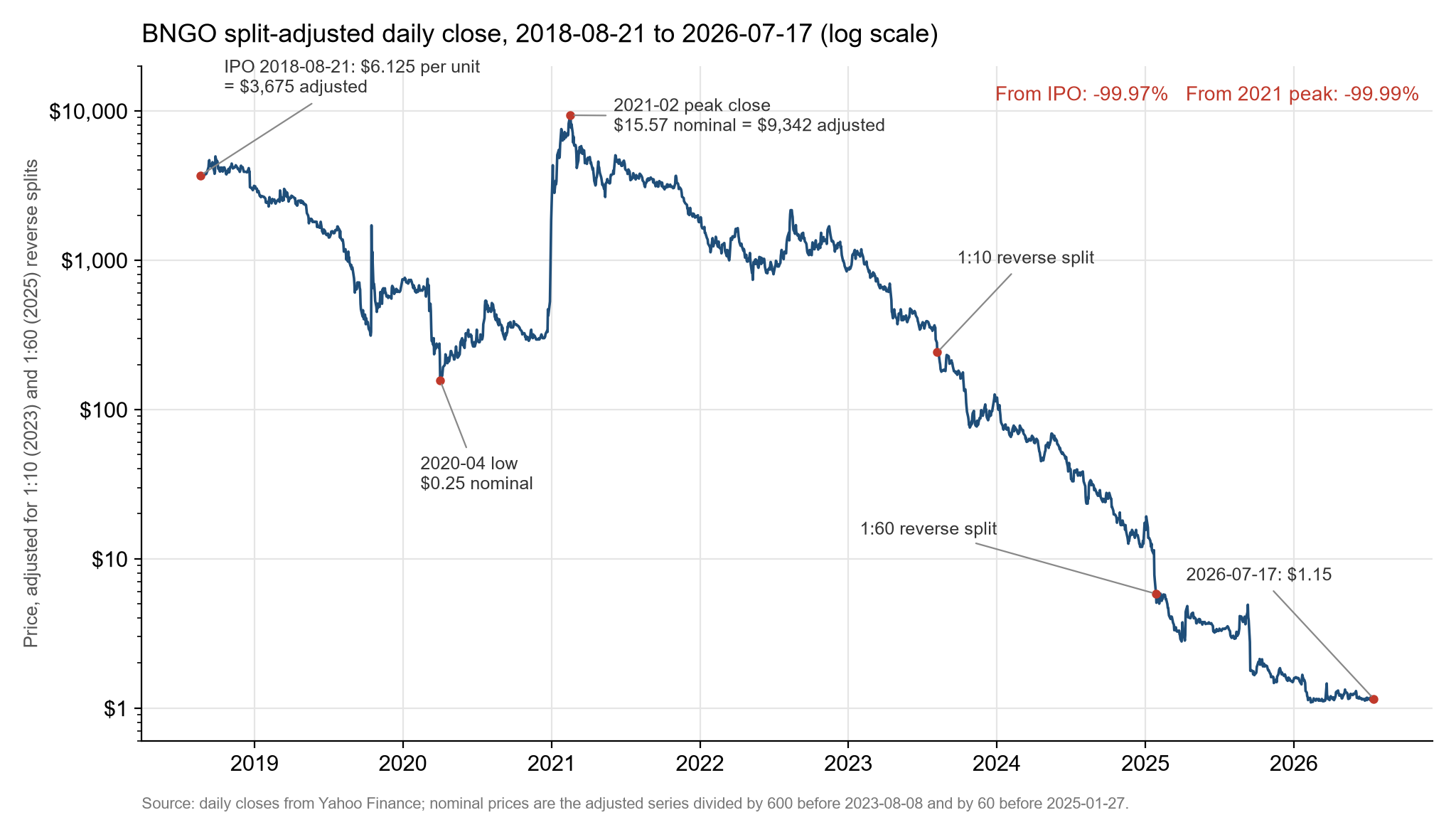
Management: Most of the ~$349M raised in that 2021 wave went into acquisitions and expansion. The three acquisitions, Lineagen, BioDiscovery and Purigen, were later either written down or shut down; only BioDiscovery's software survived, as VIA. After that came years of restructuring, layoffs and reverse splits. It is a very typical 2021 story: the money came too easily and went out too fast. The CEO of 15 years left in 2026, the chairman is now filling in, and the chief medical officer has gone too. I think the company is now at the stage of looking for a way out.
How the Technology Works
How it works: Optical Genome Mapping, OGM. The steps:
- 1 - Extract ultra-high molecular weight (UHMW) DNA, molecules ~250kb on average, the long ones reaching several Mb. Ordinary sequencing library prep does not care whether the DNA breaks, but everything in OGM rests on the molecules being long enough.
- 2 - Labeling. DLS uses one enzyme, DLE-1, to attach a fluorophore directly at the 6bp motif CTTAAG, about 16 dots per 100kb of the human genome, or one every ~6kb on average. Then the whole DNA backbone is stained.
- 3 - Straightening and imaging. Each flowcell on the chip has ~120K nanochannels about 30nm wide. Electrophoresis pushes the DNA into the channels, which are too narrow for it to coil, so it can only be pulled into a straight line, and then it is imaged at high speed. Saphyr images about 205 Gbp per hour, Stratys 530-820 Gbp.
- 4 - Analysis. Each molecule is a string of dots, effectively a barcode. Software aligns these barcodes against each other to assemble a consensus map of the whole genome, then compares it with the theoretical map computed from the reference sequence. Wherever the spacing or order of the dots disagrees, that is a structural variant.
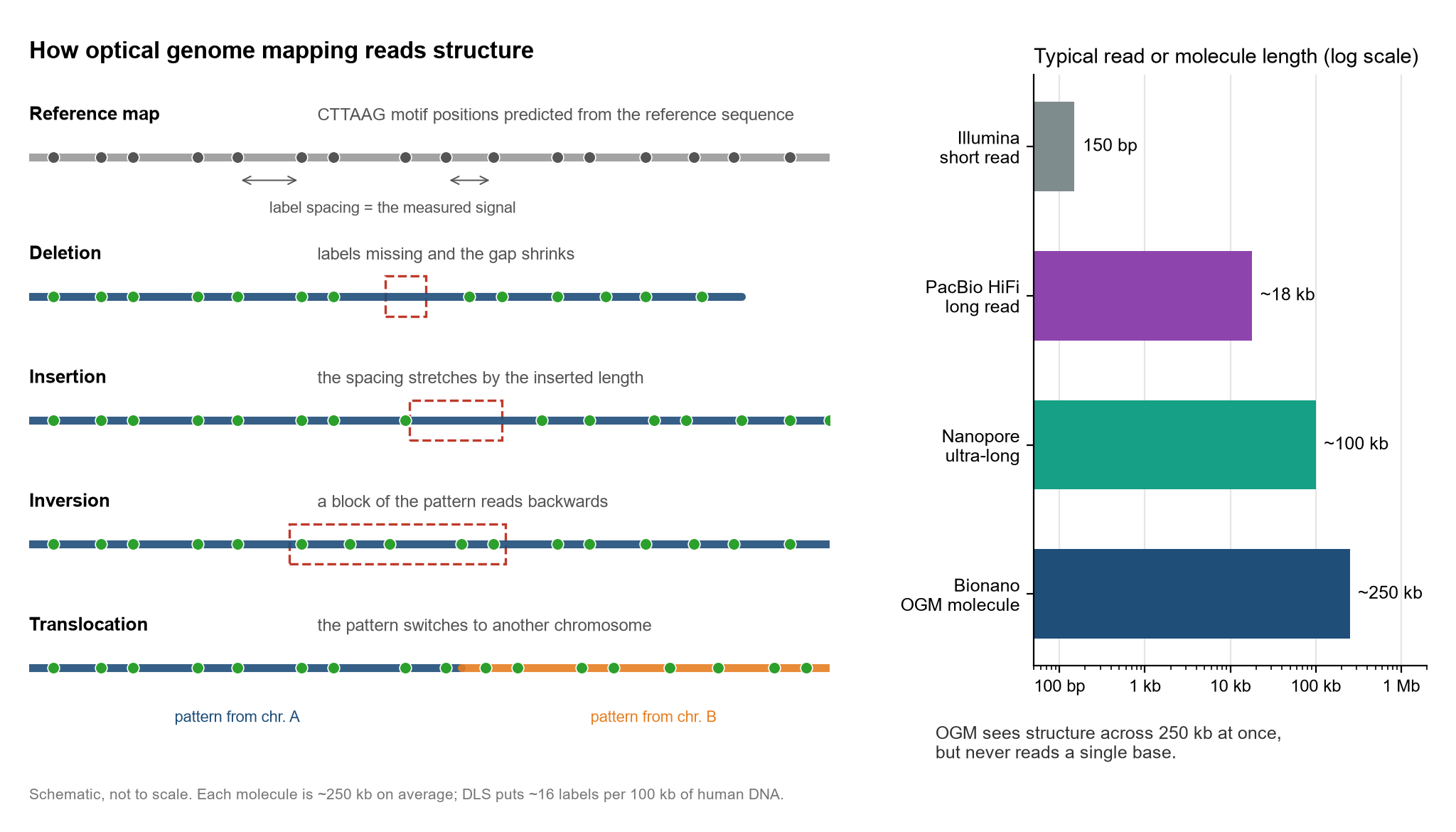
Labeling chemistry: The early method used the nicking enzyme Nt.BspQI, which recognizes GCTCTTC, cuts a single-strand nick, then fills it with a fluorescent nucleotide; this is called NLRS. The problem is that the nicks themselves make the DNA fragile, and nicks close together on opposite strands simply break the molecule, so the maps cannot be assembled long. DLS does not cut the DNA; it attaches the fluorophore directly to the motif, the molecule stays whole, and map N50 jumps to over 60Mb, basically chromosome-arm level. For assembly this improvement was a change in kind.
What it can see:
- Every type of structural variant above 500bp: deletions, insertions, duplications, inversions, translocations, copy number changes, aneuploidy.
- Balanced translocations and inversions. These are the blind spot of CMA arrays and short-read sequencing: a balanced event does not change copy number, and short reads struggle to span the repeats on either side of the breakpoint. For blood cancers this is the most important class of variant.
- Expansions and contractions of repeats, such as the D4Z4 repeat contraction in FSHD1, which is hard to do with sequencing.
- Complex rearrangements, such as chromothripsis, where a chromosome is shattered.
- Low-frequency somatic variants. At ~300x depth it can see structural variants with a variant allele frequency (VAF) as low as ~5%. That matters a lot for tumor samples.
What it cannot see:
- It cannot see bases. SNVs and small indels are completely invisible, so it has to be paired with sequencing.
- Breakpoints can only be placed to the kb level, because there are ~6kb between two dots on average. The exact breakpoint of a fusion gene still has to be confirmed by sequencing.
- Regions with no dots, or too many repeats, are invisible, such as centromeres and the short arms of the acrocentric chromosomes. Events like Robertsonian translocations are hard.
- The sample requirement is strict. It needs fresh or frozen blood, bone marrow, cells or tissue; FFPE paraffin samples basically do not work. That alone shuts out most routine pathology samples from solid tumors.
- It cannot see methylation, which long-read sequencing gives you for free.
Genome assembly: This is how I used it back then. The contigs assembled from sequencing are "digitally digested" on a computer at the CTTAAG positions into a theoretical map, then aligned to the optical map. It does three things: 1 - order and orient contigs and build them into scaffolds. 2 - use the dot spacing to estimate the length of the gaps between contigs. 3 - places that conflict with the map are often assembly errors, and can be cut there. In the era of PacBio CLR and 10x linked reads, this step was almost standard for a high-quality assembly.
- After 2019, PacBio HiFi arrived, with single reads of ~15-20kb at over 99.9% accuracy. Add Hi-C to anchor to chromosomes, and many species could be assembled straight to chromosome level. In 2022 the T2T consortium published the first complete, gapless human genome, CHM13, where Bionano was used mainly for validation.
- VGP's pipeline later made Bionano optional too: HiFi first, with Hi-C and Bionano as supplements. In other words, for assembly it went from "must have" to "nice to have". Its earliest and most distinctive use in the research market is being eaten by sequencing itself.
Technology route: The essence of optical mapping is trading very low information density (one dot every ~6kb) for a very long span and a very low cost. It does not read bases, but it sees the structure across 250kb at once, for about $500 of consumables per sample. For large structural variants, balanced translocations and low-frequency somatic variants, it is still more direct and cheaper than sequencing today. But that advantage rests on sequencing being "not long enough, not cheap enough, not deep enough", and sequencing is improving fast on all three.
Technology roadmap:
- Instruments: Stratys reached full release in 2024 with ~4x the throughput of Saphyr, up to ~13.5K human genomes at 100x per year. That said, the company's current strategy is to raise usage of the installed base rather than push new placements.
- Samples: Ionic isotachophoresis extraction aims to get ultra-long DNA from fewer cells, which might open up more sample types in the future.
- Software: VIA interprets OGM, array and NGS data in one interface. I think software is one of this company's smarter moves; the real bottleneck in a cytogenetics lab is often interpretation and reporting, not running samples.
- R&D spending is shrinking. R&D was cut from $54.03M in 2023 to $11.37M in 2025, and was only $3.14M in 2026-Q1. A company spending ~$12M a year on R&D will have a very hard time keeping up with the technology cadence of Illumina, PacBio and Oxford Nanopore.
- My view of where the technology goes: the physical method of "looking at ultra-long molecules" will be around for a long time, but it is more likely to retreat into a specialized niche. The mainstream of structural variant detection will most likely end up folded into a single sequencing run: long-read sequencing keeps getting cheaper, and in 2026-02 Illumina also unveiled TruPath Genome, built on proximity mapped reads, which adds long-range information on existing NovaSeq X instruments. One sequencing run giving SNVs, SVs and methylation together is the simpler choice for a lab.
Market and Commercialization
Research market: De novo assembly plus structural variant research. As of 2025-12-31 the global installed base was 387 instruments, and 30,171 flowcells were sold in 2025, one flowcell per sample. That works out to only ~78 samples per instrument per year, fewer than two a week. Many placements are university and institute instruments with very low usage. Assembly demand is also being replaced by HiFi + Hi-C, so I do not think the research market will be its source of growth.
Clinical: blood cancers: This is the most realistic and most promising segment. Diagnosing and classifying leukemia, myelodysplastic syndromes and multiple myeloma leans heavily on structural abnormalities at the chromosome level. The current standard is karyotyping (G-banding) plus a set of FISH probes. A karyotype needs cells cultured to metaphase first, resolves only ~5-10Mb, takes one to three weeks for a result, and depends heavily on the technician's experience. OGM needs no culture, sees the whole genome at once, and resolves several orders of magnitude finer.
- Evidence: in 2025 the International Consortium for Optical Genome Mapping (ICOGM) published expert recommendations in the American Journal of Hematology, recommending OGM as a standard cytogenetic test in the diagnostic workflow for blood cancers, for example replacing the conventional karyotype and most FISH in AML (except PML::RARA in acute promyelocytic leukemia).
- Payment: CPT 81195 is a Category I code approved in 2024, and the Medicare payment from 2026 is $1,853.22. For a test with ~$500 of consumables, the lab's economics work.
- The problem is that expert recommendations are not clinical guidelines. In the US the test pathway is really set by guidelines like NCCN and by payer policy, and OGM has not yet become a first-line test written into the mainstream guidelines. There is still a long road from "expert recommendation" to "standard workflow".
Clinical: genetic disease: Developmental delay, intellectual disability and autism after birth, prenatal diagnosis, and infertility. The current first-line test is the CMA array, which cannot see balanced translocations or inversions; OGM can fill that gap. CPT 81354 took effect in 2026 as the second Category I code. In 2026-06 the company also announced a batch of infertility studies that found a genetic cause in about a quarter of unexplained infertility. But on the genetic disease side the competitor is not the karyotype; it is clinical whole-genome sequencing, which is becoming ever more common. "Genome-first" is becoming the consensus: short-read WGS already sees CNVs and a large share of SVs, and long-read WGS entering the clinic is only a matter of time. OGM's window here is narrower than in blood cancers.
Cell and gene therapy: Gene-edited cells and iPSC cell banks need to be checked for structural abnormalities such as large deletions or translocations. The need is real, and regulators are paying more and more attention. The company estimates this as a $3.0B market, which I think is clearly too optimistic, but it is a setting that is not price-sensitive and values sensitivity, which suits OGM.
Consumer health and screening: Newborn screening, population genomics, carrier screening, consumer genetic testing. I do not think any of these are realistic for OGM in the near term. OGM needs ultra-long DNA extracted from fresh blood, and dried blood spots do not work; its throughput and cost cannot reach screening scale either. These markets will end up with sequencing.
Reimbursement and regulation: OGM instruments and reagents are RUO, research use only, with no FDA approval. Clinically, each lab validates it on its own and runs it as an LDT. On 2025-03-31 a US federal court vacated FDA's LDT rule, which is good news for the LDT route. But the company's own Bionano Laboratories shut down most of its LDTs in 2025 to save money, effectively handing clinical adoption entirely to customer labs.
Market view: The company estimates OGM's potential market at $10.0B a year: ~10K cytogenetics labs worldwide running ~10.0M samples a year. But almost eight years after listing, and more than a decade after full commercialization, revenue is only $28.74M TTM. I think the market it can actually capture is clinical cytogenetics, led by blood cancers, plus quality control for cell and gene therapy. That is a real market with real payment, but it is a "window" market: until sequencing can see SNVs and SVs together, cheaply and deeply enough, OGM is the best tool for replacing the karyotype; once sequencing gets there, labs are more likely to skip OGM entirely. My guess is this window has 5-10 years left.
Competitive Landscape
Competitive landscape:
| Method | What it sees | Main weakness |
|---|---|---|
| Karyotyping, G-banding | Whole genome at ~5-10Mb resolution, balanced translocations | Needs cell culture, slow, low resolution, manual |
| FISH | Known target loci | Only sees the probes designed in advance |
| CMA array | Genome-wide CNVs | Cannot see balanced translocations or inversions |
| Short-read WGS (Illumina) | SNVs, CNVs, some SVs | Weak in repeats and on balanced events |
| Long-read WGS (PacBio, ONT) | SNVs, SVs, methylation, phasing | High depth is still expensive |
| Proximity mapped reads (Illumina) | Long-range information on top of short reads | Just starting commercially, little clinical evidence |
| OGM (Bionano) | All SVs above 500bp, low-frequency somatic SVs | Does not read bases, strict sample requirements |
| EGM (Nabsys, Hitachi) | Reads structure electronically | Few placements and little evidence |
Long-read sequencing: This is the core long-term threat, and it happens to be the subject of the next report, PacBio. On 2024-10-29 PacBio announced SPRQ chemistry, bringing the cost of a HiFi human genome below $500, and the next-generation SPRQ-Nx targets under $300 at scale. One HiFi run gives SNVs, SVs, methylation and haplotype phasing together, far more information than OGM. The current research finding: for SVs of 1-50kb, Nanopore and OGM perform about the same; above 50kb, OGM is better. Add that blood cancers need ~300x depth to see low-frequency variants, and long reads at that depth are still too expensive. That is the ground OGM can hold today. But the edge of that ground is set by the price of sequencing.
Short reads and proximity mapped reads: Illumina unveiled constellation in 2025, renamed it proximity mapped reads in 2026-02, and unveiled the first product, TruPath Genome, at AGBT the same month. It produces long-range information directly on existing NovaSeq X instruments and is said to detect all kinds of SVs, including translocations. GeneDx is already piloting it. Bionano's long-standing vision is "an OGM instrument next to every sequencer"; Illumina's approach is to have the sequencer do that job itself. I think this is the most direct challenge to Bionano's business logic.
Traditional cytogenetics: Karyotyping and FISH are the incumbents today. Their moat is not technology but guidelines, payment, lab workflows and staff habits. The real contest for OGM is this replacement, and it moves slowly.
Other mapping technologies: Nabsys's electronic genome mapping (EGM), majority-owned by Hitachi High-Tech since 2024-08. OpGen, which did optical mapping early on, later moved into infection diagnostics. Hi-C-type methods (Arima, Dovetail) can anchor assemblies and are starting to be used to detect translocations in tumors too, and they can handle FFPE samples, which OGM cannot.
Competition view: At this point in time, for "seeing large structural variants cheaply, especially balanced translocations and low-frequency variants in blood cancers", OGM is still the best tool, with the most evidence behind it, more than 1,800 papers. But its competitor is not another mapping company; it is the cost curve of the whole sequencing industry. I think that in the long run it is more likely to end up as a specialized test alongside sequencing, or to be folded into the product line of a larger diagnostics or tools company, than to grow into a large independent platform.
Financials and Survival
Data Analysis:
| Ticker | BNGO | |
| Data As Of | 2026-07-17 | |
| Share Price | 1.15 | |
| Shares Outstanding | 11.48 M | # As of 2026-05-06. Plus ~12.1M warrants (2026-03-31). |
| Market Cap | 13.2 M | # The market cap is down to loose change. |
| Revenue | 28.74 M | # TTM, 2025-Q2 to 2026-Q1. |
| Gross Margin | 48.6% | # 2026-Q1. |
| Earning | -31.59 M | |
| PS | 0.46 | |
| PE | -0.42 | |
| Cash | 14.4 M | # Cash plus short-term investments at 2026-03-31. Another 10.3M of restricted funds went to pay off the convertible debentures on 2026-05-26. |
| FCF (-SBC) | -22.9 M | |
| Cash Runway | 0.63 | # The company's own line is that it lasts into 2027-Q1. |
| Dilution 3Y | 2144% | # 2023-05 to 2026-05, split-adjusted. |
| Dilution 1Y | 241.1% | |
| Installed Base | 387 | # 2025-12-31. |
| Flowcells 2025 | 30,171 | # ~78 samples per instrument per year on average. |
Revenue trend: Revenue peaked at $36.12M in 2023 and fell back to ~$28-29M over the next two years. The loss narrowed from -$232.49M in 2023 to -$26.39M in 2025, mainly by cutting costs, not by growing. Cash peaked at $362.1M in early 2021 and was down to $14.4M at 2026-03-31. Split-adjusted, the share count has grown ~687x since the listing.
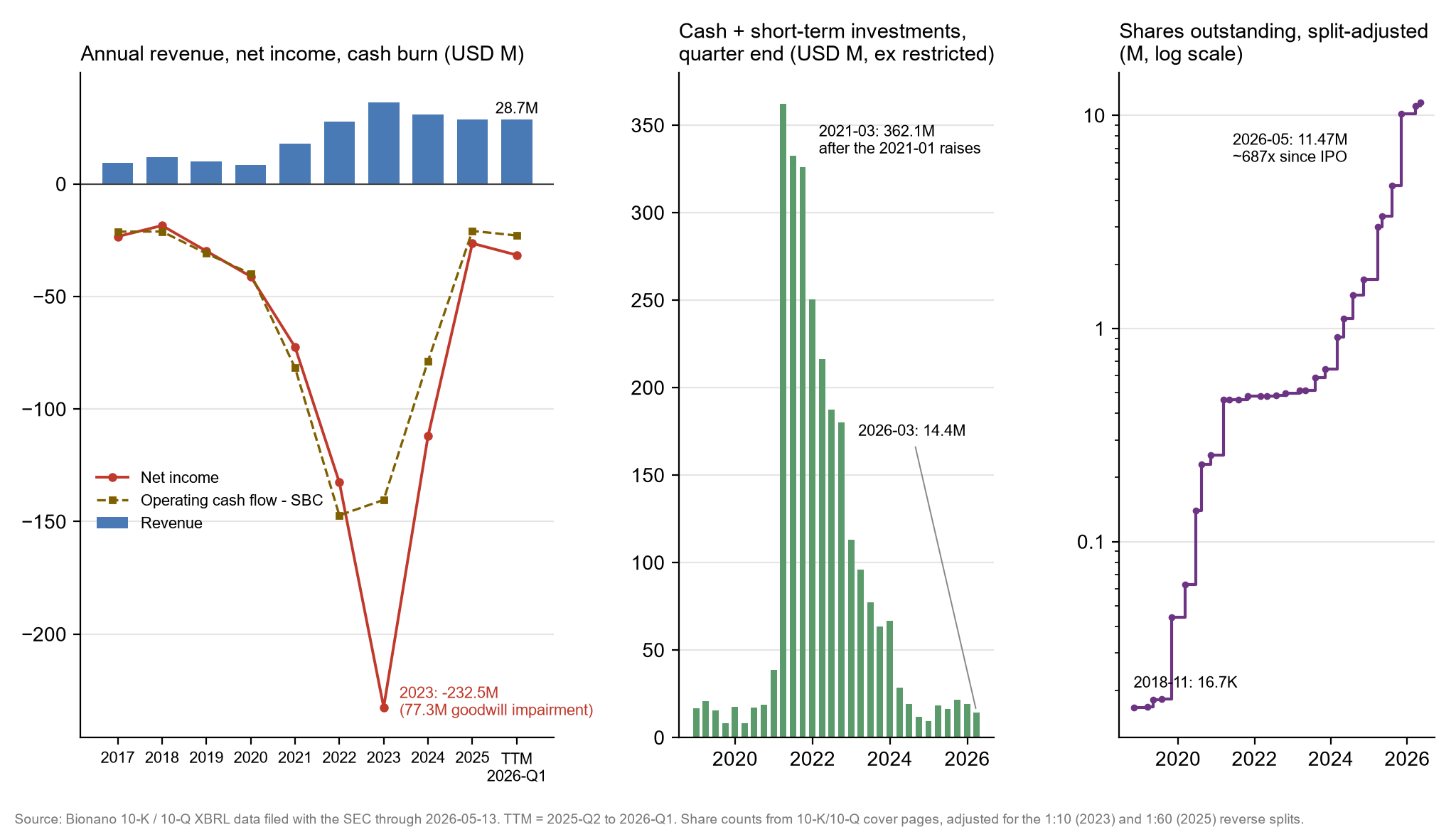
Revenue mix: 2026-Q1 revenue was $6.69M, up 4% year over year. Consumables were $3.90M, up 20%, on 8,178 flowcells, up 17%; that is the healthiest piece. Instruments were $0.96M, software $1.23M (down 40%), services $0.59M. By region, Europe, the Middle East and Africa were 53% and the Americas only 37%. Gross margin was 48.6%, but quarterly operating expenses were $11.1M against only $3.3M of gross profit, a long way from breaking even. The company's 2026 revenue guidance is $30-33M.
Cash and financing: Both the annual report and the 2026-Q1 quarterly report carry going-concern language, substantial doubt about its ability to continue as a going concern, and say outright that it may file for bankruptcy protection if it cannot raise money. The good news is that the secured convertible debentures were paid off on 2026-05-26, so its assets are no longer pledged. On 2026-05-08 the company filed a new S-3 shelf registration. Add ~12.1M warrants, with the E and F series exercisable at $2.00, and I think another raise in the second half of 2026 is all but certain, with more dilution. The board also has a strategy committee weighing options that include selling the company.
References
- The methods paper for Bionano's nanochannel mapping, with both Han Cao and Alex Hastie among the authors. The average label spacing at the time was ~9kb.
- The new rat reference genome I worked on, built on the classic combination of PacBio CLR + 10x + Bionano DLS + Hi-C.
- For SVs of 1-50kb, Nanopore and OGM perform about the same; above 50kb, OGM is better. At 300x depth, VAF can go as low as ~5%.
- The ICOGM expert recommendations, the most important endorsement OGM has in blood cancers.
- The cost curve of long reads is the line that decides how long OGM's window stays open.
2025-01 Introducing constellation mapped read technology - Illumina
- Illumina producing long-range information directly on the sequencer, renamed proximity mapped reads in 2026-02.
- 81195 rose from $1,263.53 to $1,853.22.
2026-03-23 Bionano Genomics 2025 Form 10-K - SEC
- The installed base, flowcells, market estimates, going-concern language and financing history all come from here.
2026-05-13 Bionano Reports First Quarter 2026 Results and Provides a Business Update - Bionano
- The latest quarter's numbers and the 2026 guidance.
My View
Current view: OGM is a real, useful technology. In clinical cytogenetics, especially blood cancers, it is better than a karyotype plus FISH, and the evidence and payment are gradually falling into place. But its advantage rests on sequencing being not long enough, not cheap enough and not deep enough, and long-read sequencing and Illumina's new technology are slowly taking that premise away. In assembly I watched it go from required to optional with my own eyes, and I think the same thing will happen again in cytogenetics, more slowly. At the company level, revenue is stuck at ~$29M, R&D has been cut to ~$12M a year, cash only lasts into early 2027, and dilution will continue. The technology will most likely survive, whether in Bionano's own hands or folded into a larger company; but as an independent company it faces a great deal of uncertainty. No position at the moment.
Working title: A good technology whose window sequencing is slowly closing.