Contents
Key Summary
2026-08-21 Current view: I think HiFi has won on technology, and clinical studies and large genome data projects are turning it into routine workflows. What PacBio hasn't proven is whether those workflows bring steady repeat consumables and enough gross margin. Consumables were already half of 2026-Q2 revenue, but annual revenue is still ~$160M, gross margin only ~32%, and TTM free cash flow -$123M. I watch three things together: patient-level evidence, usage per instrument, and consumables and gross margin. A bigger long-read market doesn't automatically mean PacBio makes money. No current position.
2026-08-21 Technology route: PacBio's core is "long and accurate", plus a very mature set of assembly, phasing and variant-analysis tools. I think that advantage is still clear, but Q30 is no longer PacBio's alone: Nanopore duplex gets to around Q30 too. What really matters now is how much of the data is usable high-quality data, what effective coverage costs, and whether hard-to-call variants come out reliably.
2026-08-21 Clinical evidence: In the NEJM study published on 2026-06-13, covering 832 index patients at two centers, long reads diagnosed 160 and standard testing diagnosed 137: 19.2% versus 16.5%. I find this more convincing than comparing accuracy alone, but the 2.7 percentage-point gain is the result of this patient group and this workflow. The next questions are whether another hospital can reproduce it, whether it cuts out rounds of testing, and what each diagnosis costs in total.
- Between research and routine testing sit sample standards, reference databases, variant classification, review and reporting. Seeing SNVs, SVs, repeat expansions and methylation in one run doesn't mean a lab can drop all its other tests right away. I care more about how many new diagnoses it adds, how long results take and what each diagnosis costs than about a read-level Q score in a paper.
- Payment is another hurdle. Test pricing, insurance coverage and hospital budgets have to be worked out market by market, and there is no sign yet of stable reimbursement for long reads everywhere.
2026-08-21 Business conversion: Selling the instrument is only the first step. Customers need a steady stream of samples and a workflow that runs smoothly before they keep buying SMRT Cells and reagents, and PacBio has to make enough gross margin on consumables to pay for R&D and support. I judge commercialization along one chain: sample demand, workflow adoption, instrument use, repeat consumables, gross profit. Clinical evidence and big projects are only the starting point; steady profits are still a long way off.
2026-08-21 Competitive landscape: Before comparing competitors you have to say what you're comparing. Assembly is about read length and phasing; clinical testing is about calling variants reliably and producing a report; big data projects are about useful output, failure rates and total cost. The table below is positioning, not a scorecard.
| Company | Technology | Key traits |
|---|---|---|
| PacBio | HiFi circular-consensus long reads | 15-20kb, Q30+ consensus reads; methylation in the same run |
| Oxford Nanopore | Nanopore long reads | Flexible read length and equipment; simplex and duplex differ in accuracy and yield |
| Illumina | Short reads + proximity mapped reads | Largest market, among the lowest costs, launched TruPath Genome in 2026 to add long-range information |
| Roche | SBX nanopore sequencing (AXELIOS 1) | Unveiled 2026-06, built around speed and cost |
| Ultima, Element, MGI | Short reads | Built around low cost, pushing down the price of all sequencing |
| Bionano | Optical mapping | Does not read bases, looks at large-scale structure |
2026-08-21 Data Analysis:
| Ticker | PACB | |
| Data As Of | 2026-08-21 | |
| Share Price | 1.35 | |
| Shares Outstanding | 310.8 M | # As of 2026-07-31. |
| Market Cap | 419.6 M | |
| Revenue | 159.3 M | # TTM, 2025-Q3 to 2026-Q2. 2026 guidance 155-165M. |
| Gross Margin | 32.4% | # 2026-Q2 GAAP. Very low for a sequencing company. |
| Earning | -131.4 M | # TTM. 2026-Q1 includes a one-off 45.8M gain on selling the short-read assets. |
| PS | 2.63 | |
| PE | Not applicable | # Loss-making. |
| Cash | 236.9 M | # Cash and investments at 2026-06-30. |
| Convertible Notes | 641.0 M | # 200M due 2029, conversion price 4.89; 441M due 2030, conversion price 21.50. |
| FCF | -123.4 M | # TTM OCF - capex. |
| FCF (-SBC) | -157.7 M | # TTM OCF - capex - SBC. |
| Cash Runway | About 1.92 years | # 236.9 / 123.4. |
| Dilution 3Y | 24.0% | |
| Dilution 1Y | 3.5% | |
| Revio 2025 | 61 units | # 97 units in 2024. |
| Vega 2025 | 140 units |
Complete Notes
Personal Experience
Personal experience: The rat reference genome I worked on, mRatBN7.2, used PacBio CLR for its long reads. Single-read error rates back then were around 10-15%, so the reads had to be corrected first and then combined with 10x linked reads, Bionano optical maps and Hi-C for scaffolding and validation. Each data type covered a different gap: bases, molecular linkage, physical maps and chromosome contacts. You needed all of them. I won't go into the details of my role or the collaboration here.
- Then HiFi arrived and single-read accuracy went above 99.9%, which removed many steps that used to need several technologies stitched together. But accurate reads don't automatically give you a complete assembly: complex repeats, haplotype phasing and chromosome-level scaffolds can still need ultra-long reads and Hi-C. Bionano and linked reads went from must-have to optional in assembly.
Company History
Before the IPO:
- The predecessor, Nanofluidics, was founded in 2000. The technology came out of Cornell's single-molecule and nano-optics research, with Stephen Turner and Jonas Korlach at the core. A 2003 Science paper introduced the zero-mode waveguide (ZMW): a way to watch a single molecule even in a concentrated solution.
- Institutional funding started in 2004, and the company took the Pacific Biosciences name. It was an expensive start: chips, optics, polymerase, reagents and analysis software all had to be built in house, and the instrument wouldn't work if any one of them was missing.
- 2009: published single-molecule real-time sequencing in Science, one step away from commercialization.
IPO: Listed on Nasdaq on 2010-10-27 at $16 a share, raising $200M. The story then was "third-generation sequencing": single-molecule long reads taking on Illumina.
After the IPO:
- 2011: the first instrument, the PacBio RS, came out, but its single-read error rate was as high as ~15% and its throughput was low, and the market soon soured on it. The share price fell from $16 to around $2, with layoffs at year end. It bottomed at $1.10 in 2012-11.
- 2013-2015: the RS II and steadily improving chemistry kept lengthening the reads, and it found its place assembling bacterial, plant and animal genomes. Sequel launched in 2015, and revenue reached nearly $93M for the first time.
- 2018-11: Illumina announced it would buy PacBio for $8 a share, about $1.2B; the share price jumped from $4.51 to $7.56 that day.
- 2019: Sequel II launched. The same year Wenger et al. published the HiFi method in Nature Biotechnology: circular consensus sequencing, 13.5kb average read length, 99.8% accuracy. This was PacBio's most important technical turning point.
- 2020-01: the FTC sued to block the deal for "eliminating nascent competition", Illumina walked away and paid PacBio a $98M break fee. Christian Henry became CEO the same year.
- 2021: in February SoftBank bought $900M of convertible notes with a $43.50 conversion price. The stock closed at $51.15 on 2021-02-11, its highest since the listing. In September it spent about $715M buying Omniome, a short-read sequencing company, aiming to do both long and short reads.
- 2022-10: launched the high-throughput Revio, 25M ZMWs per SMRT Cell, billed as a 30x human genome for under $1,000. 2023 revenue rose to $200.5M, the highest ever.
- 2023-2024: Onso, the short-read sequencer built on Omniome's technology, launched but sold poorly. In 2024 came layoffs and $184.5M of goodwill and intangible impairments. In 2024-10 SPRQ chemistry brought a HiFi human genome under $500; in 2024-11 the Vega benchtop launched at $169K. The same month it restructured its debt with SoftBank, swapping the remaining $459M of 2028 convertible notes for $200M of 2029 convertible notes, 20.5M shares and $50M in cash.
- 2025: in the first quarter it decided to stop the high-throughput short-read program, took a one-off $359.3M accelerated amortization of the Omniome technology, and lost -$546.4M for the year. The stock hit a low of $0.91 in 2025-05.
- 2026: in January it sold its short-read intellectual property to Illumina for $50M. In March it settled a patent suit with Taiwan's PGI. Also in March, Basecamp Research picked PacBio to sequence ~100K metagenomic samples for its Trillion Gene Atlas. In May SPRQ-Nx chemistry rolled out fully, at a $345 list price per human genome. On 2026-07-30 the board approved another restructuring, cutting ~8% of staff and another $30-40M of annualized operating expenses by the end of 2027. On 2026-08-05 COO Mark Van Oene took over as CEO from Christian Henry.
Share price: From the $16 IPO price to $1.35 on 2026-08-21 is a 91.6% fall; from the 2021 high it is 97.4%. PacBio has never split its stock, but the share count keeps growing: ~86M shares in early 2016, 310.8M now, 3.6x in ten years.
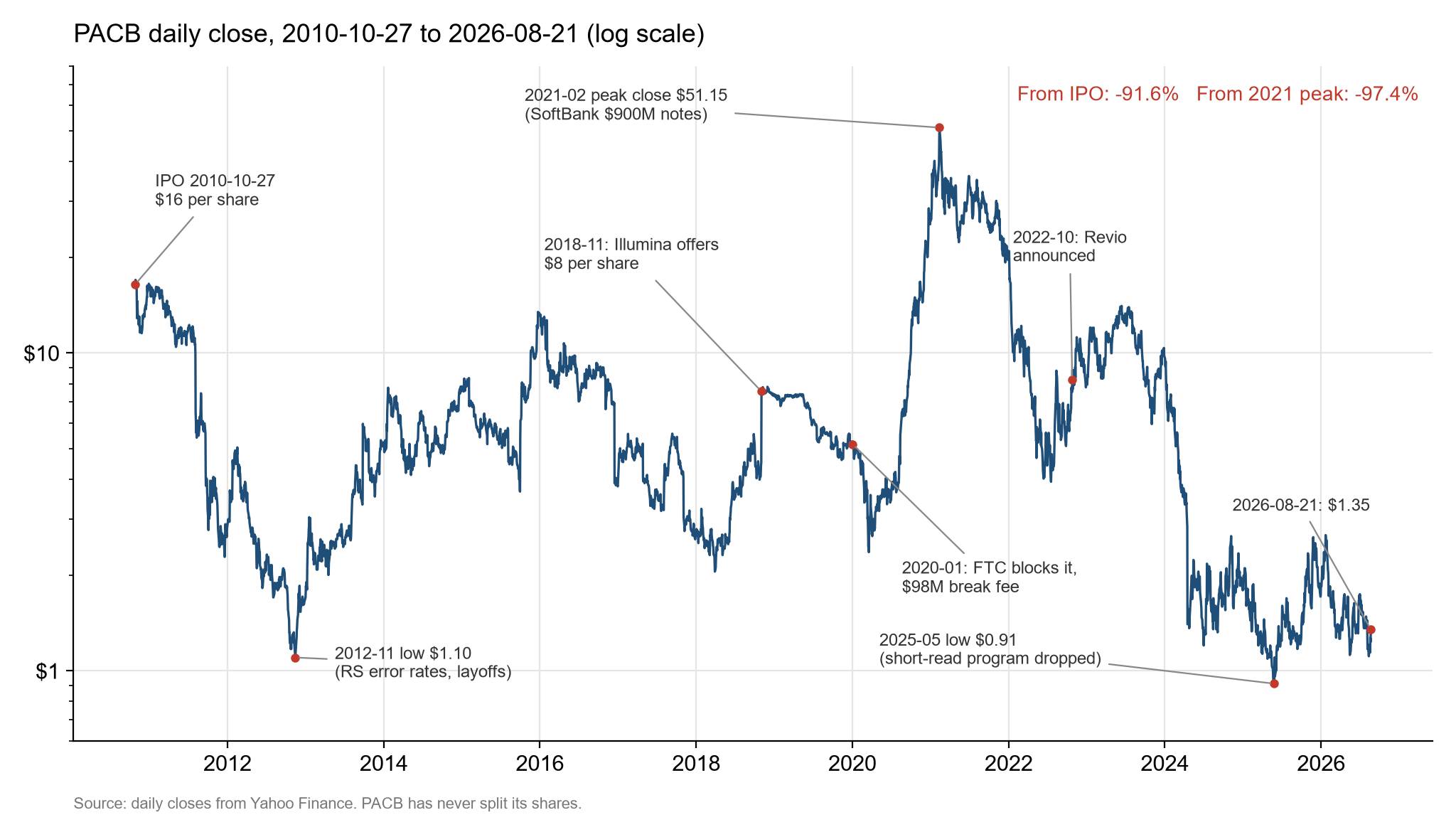
Management: The technology kept getting better while shareholders kept losing money. Those are two very different curves. The company had two near misses: in 2018 it almost became part of Illumina, and in 2021 it tried to do long and short reads at once with SoftBank's money and Omniome. The second one was expensive: Omniome cost about $715M, and the short-read assets were eventually sold for $50M. Under Christian Henry, PacBio launched Revio and Vega and HiFi found more and more uses, but the short-read money was largely wasted. Mark Van Oene became CEO on 2026-08-05; the July restructuring was decided before he took over. I think the question for the new CEO is simple: now that it only does long reads, can it grow usage and gross profit?
How the Technology Works
How it works: SMRT, Single Molecule Real-Time sequencing. In a few steps:
- 1 - ZMW, zero-mode waveguides. The chip has tens of millions of holes only tens of nanometers across, smaller than the wavelength of light, so light only illuminates a very thin layer at the bottom of each hole. One DNA polymerase is fixed at the bottom of each hole.
- 2 - Watching synthesis in real time. Each of the four nucleotides carries a different fluorescent color, attached to the phosphate. Each time the polymerase adds a base it lingers at the bottom for tens of milliseconds and gives off a flash; once the base is added, the fluorophore is cut off with the phosphate and drifts away. The camera films continuously, and a string of flashes is a string of bases.
- 3 - The SMRTbell circular template. Hairpin structures are joined to both ends of double-stranded DNA, turning it into a loop. The polymerase can read around the loop lap after lap, so both strands of the same molecule are read many times.
- 4 - Circular consensus (CCS). Most errors in a single pass are random, so reading the same position many times cancels them out. Stacking the laps and taking a consensus gives long, accurate HiFi reads. Revio also runs DeepConsensus, co-developed with Google, on the instrument to push accuracy further.
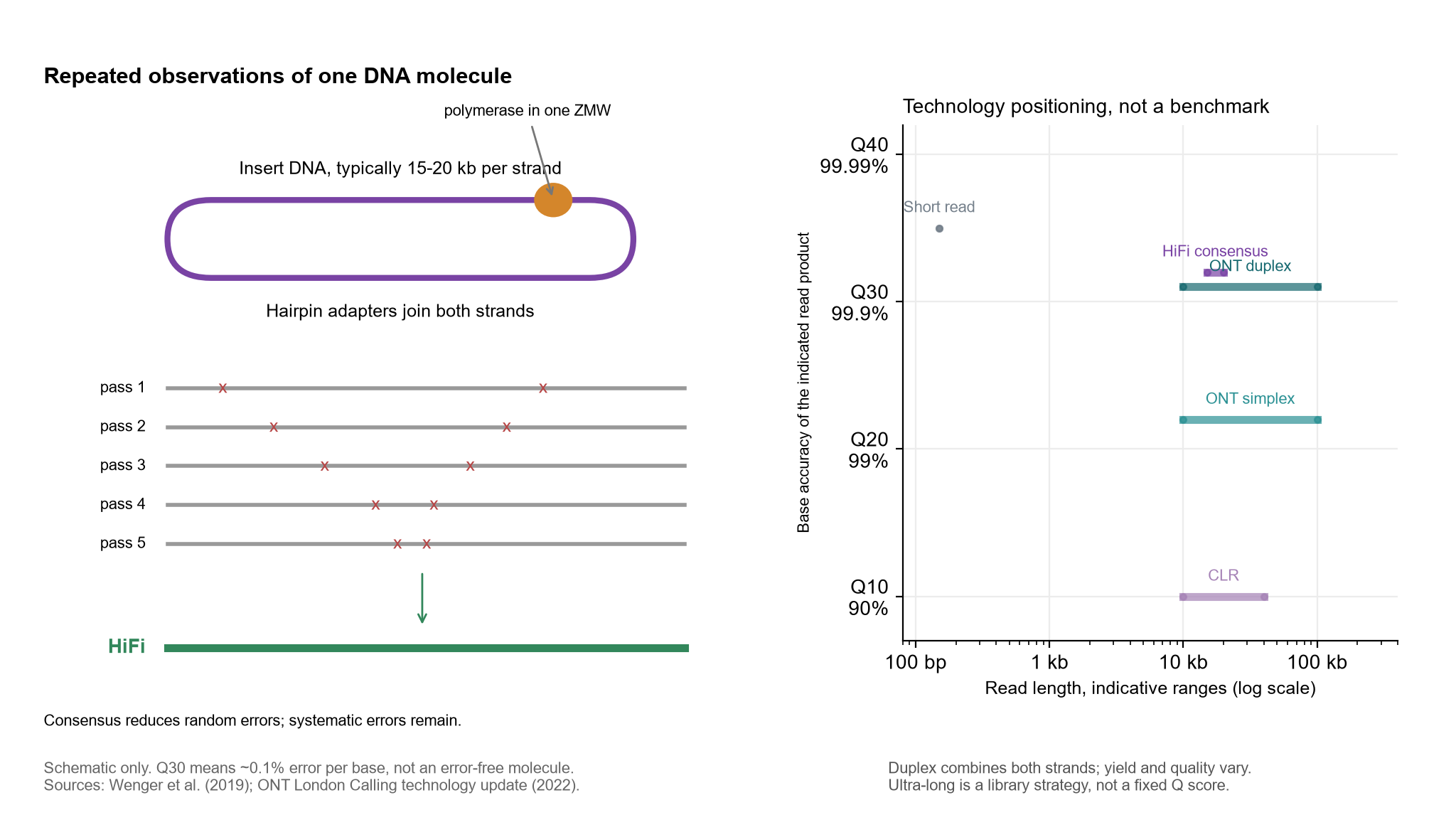
From CLR to HiFi: CLR is one long continuous read with a 10-15% error rate; HiFi reads the same loop many times and takes a consensus, usually 15-20kb at Q30 or above. Q30 means a 0.1% error rate per base, not a 20kb read without a single error. The longer the fragment, the fewer laps fit, so accuracy and output trade off. I think HiFi's biggest contribution is that the raw material for assembly and variant calling suddenly became clean, and most of the time we used to spend on error correction went away.
What it can do:
- One run sees SNVs, small indels, structural variants, repeat expansions and methylation together, and can also separate the two copies of each chromosome (haplotype phasing).
- Methylation comes straight from the polymerase kinetics, no bisulfite conversion needed: a modified base changes the spacing and length of the flashes. It can see 5mC and 6mA, but reliability differs by modification and sample, so each needs its own validation.
- High-quality de novo assembly. The T2T consortium's first complete human genome in 2022, the Human Pangenome Reference Consortium (HPRC) and VGP's species reference genomes all rest mainly on HiFi data.
- Full-length transcripts with Iso-Seq, and Kinnex, which strings short fragments into long ones to raise throughput, used for single-cell and 16S.
- The targeted PureTarget, for repeat expansions such as Huntington's disease and fragile X, and for carrier screening.
Technical boundaries:
- DNA requirements. It needs high molecular weight DNA, pickier than Illumina about samples, though far less so than Bionano. What it can do with FFPE samples is limited.
- A ceiling on read length. HiFi sits mainly at 15-20kb; for ultra-long reads of hundreds of kb, Nanopore is stronger. T2T assembled the centromeres with HiFi plus Nanopore ultra-long reads.
Technology route: PacBio's core is "long and accurate", plus a very mature set of assembly, phasing and variant-analysis tools. I think that advantage is still clear, but Q30 is no longer PacBio's alone: Nanopore duplex gets to around Q30 too. What really matters now is how much of the data is usable high-quality data, what effective coverage costs, and whether hard-to-call variants come out reliably.
Technology roadmap:
- 2022, Revio with 25M ZMWs; 2024, SPRQ, a human genome under $500; 2026, SPRQ-Nx, with reusable SMRT Cells, at a $345 list price per human genome and a target under $300 at scale.
- 2024, the Vega benchtop, bringing HiFi to small labs. But in 2026 Vega has sold worse than expected.
- In 2025 it dropped high-throughput short reads, and in 2026 it sold the short-read intellectual property to Illumina. I think that was right: short reads are already crowded with Illumina, Element, Ultima and MGI, and PacBio does not have the resources to fight two wars at once.
- My view of the technology: long reads will become the default for more and more clinical genome and reference genome projects, but they won't replace short reads any time soon. For narrow targets, fragmented samples, or high-volume SNV work, short reads still fit better. PacBio has to defend its lead with effective data cost, automation and clinical workflows; it can't count on Nanopore never catching up.
Market and Commercialization
Research market: Academic institutions, genome centers and plant and animal research are PacBio's base. The problem is that instruments are bought with research funding, and with NIH and academic funding unsettled from 2025, Revio sold only 61 units in 2025, more than a third fewer than the 97 in 2024. Consumables are growing, with 2025 consumables revenue of $82.0M, up 16%, but annualized consumables pull-through per Revio fell from ~$229K in 2026-Q1 to ~$202K in Q2. The research market is there, but growth has to come from elsewhere.
Clinical: rare disease: Rare-disease diagnosis has to answer "why is this patient sick", not just produce more bases. Today's workup can mean an exome or short-read genome, a CMA array, repeat-expansion tests and methylation tests. HiFi's appeal is seeing all of that in one run, so clues that used to sit in several separate reports can be read together. How many tests it can actually replace depends on the patient population and the validation.
Clinical evidence: In the NEJM study published on 2026-06-13, covering 832 index patients at two centers, long reads diagnosed 160 and standard testing diagnosed 137: 19.2% versus 16.5%. I find this more convincing than comparing accuracy alone, but the 2.7 percentage-point gain is the result of this patient group and this workflow. The next questions are whether another hospital can reproduce it, whether it cuts out rounds of testing, and what each diagnosis costs in total.
- Between research and routine testing sit sample standards, reference databases, variant classification, review and reporting. Seeing SNVs, SVs, repeat expansions and methylation in one run doesn't mean a lab can drop all its other tests right away. I care more about how many new diagnoses it adds, how long results take and what each diagnosis costs than about a read-level Q score in a paper.
- Payment is another hurdle. Test pricing, insurance coverage and hospital budgets have to be worked out market by market, and there is no sign yet of stable reimbursement for long reads everywhere.
Population genomics and AI data: Basecamp Research picked PacBio in 2026 to deeply sequence ~100K metagenomic samples, and sequencing and delivery had started by Q2. These are 100K environmental microbial samples, not 100K human genomes, and not yet locked-in revenue. HiFi's value here is reading complete genes, strains and their genomic context together; assemblies from short fragments are too ambiguous to make good training data. I find this direction interesting, but it still comes down to contracts, delivery and repeat orders, and AI companies care about cost too.
Other applications: Agricultural breeding, microbiology, full-length transcripts and single-cell are all real markets. Iso-Seq reads complete splice forms, and Kinnex strings short fragments together to raise output per run, though single-cell still depends on other companies' barcoding and library kits. Cancer research has demand too, but low-frequency somatic variants need very deep coverage and FFPE DNA is fragmented, so costs get high. I don't think "can sequence it" means it fits clinical tumor samples.
Reimbursement and regulation: PacBio's products are all research use only (RUO); it has no approved diagnostic product. Clinically, each lab validates and runs it on its own. One diagnostic paper doesn't solve regulation, quality systems or payment.
Reasons to pay: Different customers want different things. Reference-genome projects want the most complete structure, clinical labs want variants they can interpret and report, and microbial and AI data projects want coherent genes with their genomic context. All of these need long reads, but procurement, sample volumes and repeat-order patterns are completely different. An assembly paper, a clinical study and a big data contract are three different kinds of growth.
Market view: Long reads are still a small part of the sequencing market. PacBio's 2025 revenue was $160.0M and Oxford Nanopore's was £223.9M. I think the best chances to scale are complex genetic disease, population and pangenome projects, and complete microbial data. Consumer health, screening healthy people and consumer genetic tests first have to show that the extra findings change decisions, and they bring incidental findings and interpretation burden. A market sized by multiplying a potential population by the sequencing price is not the market PacBio can actually capture.
Competitive Landscape
Competitive landscape: Before comparing competitors you have to say what you're comparing. Assembly is about read length and phasing; clinical testing is about calling variants reliably and producing a report; big data projects are about useful output, failure rates and total cost. The table below is positioning, not a scorecard.
| Company | Technology | Key traits |
|---|---|---|
| PacBio | HiFi circular-consensus long reads | 15-20kb, Q30+ consensus reads; methylation in the same run |
| Oxford Nanopore | Nanopore long reads | Flexible read length and equipment; simplex and duplex differ in accuracy and yield |
| Illumina | Short reads + proximity mapped reads | Largest market, among the lowest costs, launched TruPath Genome in 2026 to add long-range information |
| Roche | SBX nanopore sequencing (AXELIOS 1) | Unveiled 2026-06, built around speed and cost |
| Ultima, Element, MGI | Short reads | Built around low cost, pushing down the price of all sequencing |
| Bionano | Optical mapping | Does not read bases, looks at large-scale structure |
Oxford Nanopore: This is the most direct rival. 2025 revenue was £223.9M, up 22.2%, or 24.2% at constant currency, growing faster than PacBio. Its strengths are ultra-long molecules, real-time reads, and a full device range from handheld to high-throughput. Simplex usually sits around Q20, but duplex reads both strands of the same DNA, and the company showed data around Q30 back in 2022. Comparing HiFi with Nanopore's most basic simplex and concluding that "PacBio is always more accurate" is wrong. I think what matters is how much DNA ends up as usable high-quality data, and who is cheaper and more consistent for the same clinical goal.
Illumina: In 2026-02 at AGBT it unveiled TruPath Genome, built on proximity mapped reads, which adds long-range information directly on existing NovaSeq X instruments and is said to fully phase 98% of genes, as well as see structural variants and STRs. It is not true long-read sequencing, but for many clinical labs "some long-range information without changing instruments" may well be enough. That squeezes PacBio's space in the clinic for "things only long reads can do".
New players: Roche unveiled the SBX-based AXELIOS 1 on 2026-06-29, built around same-day whole-genome results. Ultima pushes the $100 genome. These are mainly a price war in short reads, but they keep pushing down the anchor for "what a human genome should cost".
The difference from Bionano: Bionano only sees structure and doesn't read bases; PacBio gets sequence, long-range information and methylation in one dataset. So PacBio can compete for far more workflows than Bionano, but it also faces short-read pricing and ecosystem and Nanopore's flexibility at the same time. In the last report I called Bionano a "window" business. PacBio is different: its problem is not whether the technology gets replaced, but whether labs are willing to hand a long-running workflow to HiFi.
Competition view: I think HiFi is still the best at accurate long reads with mature analysis tools. But Nanopore's devices and read lengths are more flexible, and short reads are adding long-range information. This market will grow; how much PacBio gets depends on whether clinical use becomes routine and whether large-scale data production takes off.
What Each Instrument Earns
Business conversion: Selling the instrument is only the first step. Customers need a steady stream of samples and a workflow that runs smoothly before they keep buying SMRT Cells and reagents, and PacBio has to make enough gross margin on consumables to pay for R&D and support. I judge commercialization along one chain: sample demand, workflow adoption, instrument use, repeat consumables, gross profit. Clinical evidence and big projects are only the starting point; steady profits are still a long way off.
The customer’s complete cost:
- What the price covers. SPRQ-Nx's $345 is sequencing reagents for a 20x human genome, not 30x, and certainly not the full cost of a clinical test. DNA extraction, library prep, instrument depreciation, failed reruns, storage, analysis and interpretation all come on top. The same goes for $100 or $200 short-read genomes: check the coverage, the batch size and what's included, rather than comparing the numbers in the ads.
- Throughput and utilization. Revio can run several SMRT Cells at once, but output depends on DNA quality, loading, coverage targets and run time. An instrument only gets economies of scale if it always has samples to run. The annualized pull-through the company reports is one quarter of consumables annualized, not the real yearly revenue of each instrument.
What I would watch: What I most want to see is usage going up while repeat consumables and gross profit go up with it. More placements, one good quarter of consumables or cheaper reagents don't prove anything on their own. Price cuts bring more users but also mean more samples are needed to earn the money back; Vega lets small labs use HiFi, but whether small labs run it often is another question.
Financials and Survival
Data Analysis:
| Ticker | PACB | |
| Data As Of | 2026-08-21 | |
| Share Price | 1.35 | |
| Shares Outstanding | 310.8 M | # As of 2026-07-31. |
| Market Cap | 419.6 M | |
| Revenue | 159.3 M | # TTM, 2025-Q3 to 2026-Q2. 2026 guidance 155-165M. |
| Gross Margin | 32.4% | # 2026-Q2 GAAP. Very low for a sequencing company. |
| Earning | -131.4 M | # TTM. 2026-Q1 includes a one-off 45.8M gain on selling the short-read assets. |
| PS | 2.63 | |
| PE | Not applicable | # Loss-making. |
| Cash | 236.9 M | # Cash and investments at 2026-06-30. |
| Convertible Notes | 641.0 M | # 200M due 2029, conversion price 4.89; 441M due 2030, conversion price 21.50. |
| FCF | -123.4 M | # TTM OCF - capex. |
| FCF (-SBC) | -157.7 M | # TTM OCF - capex - SBC. |
| Cash Runway | About 1.92 years | # 236.9 / 123.4. |
| Dilution 3Y | 24.0% | |
| Dilution 1Y | 3.5% | |
| Revio 2025 | 61 units | # 97 units in 2024. |
| Vega 2025 | 140 units |
Revenue trend: Revenue peaked at $200.5M in 2023, the year Revio had just launched and customers bought instruments in a rush. It fell back to ~$155-160M over the next two years, and 2026 guidance is still $155-165M. Net losses in 2022-2024 were around $300M a year, reaching -$546.4M in 2025 because of the one-off amortization of the short-read technology. Cash peaked at $1,160M in 2021-03 after SoftBank's money came in, and was down to $236.9M by 2026-06.
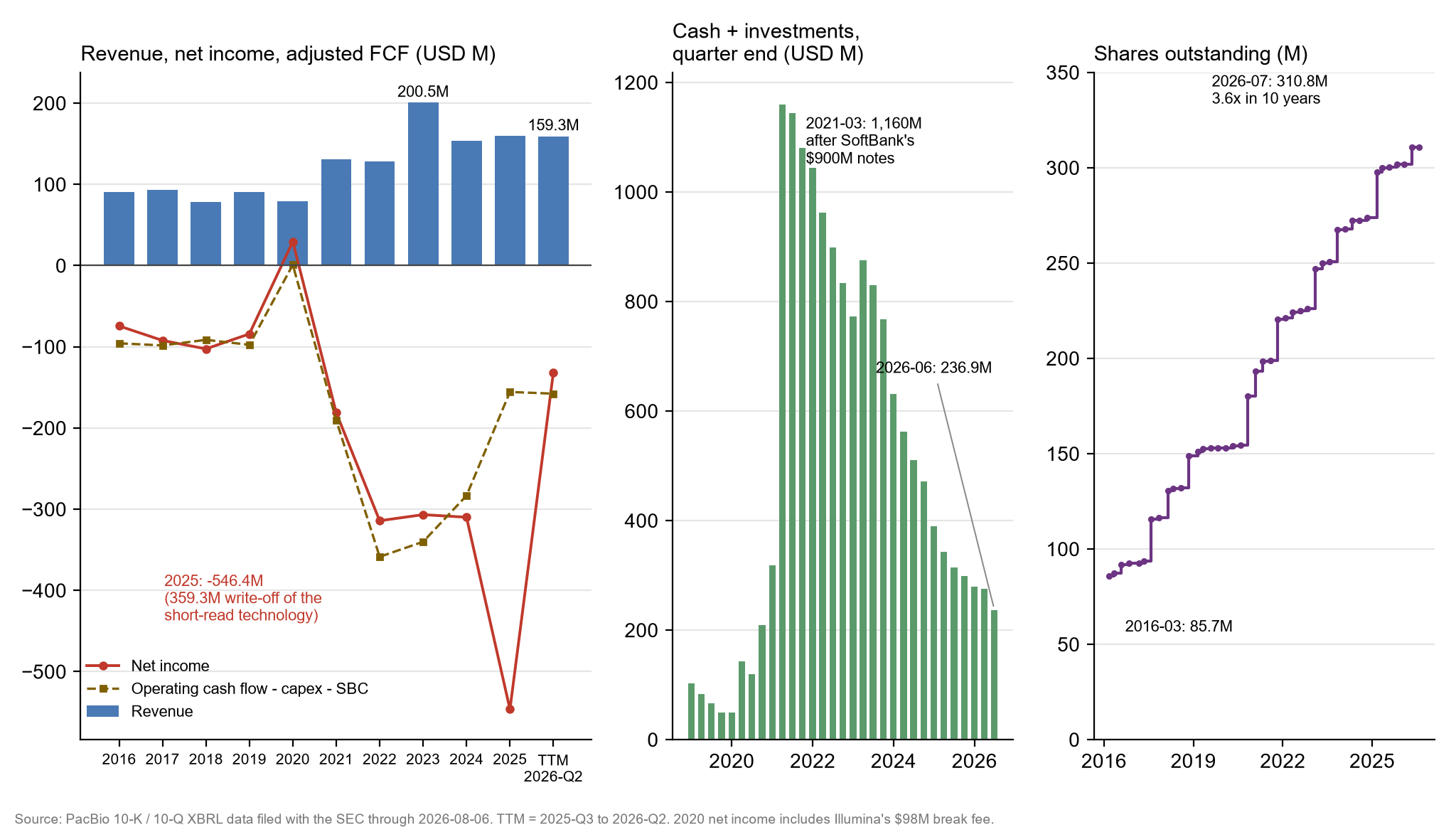
Revenue mix: 2026-Q2 revenue was $39.0M, down 2% year over year. Consumables were $20.1M, up 6%; instruments $12.8M, down 10%; services $6.1M. Q2 placements were 20 Revio and 26 Vega. GAAP gross margin was 32%, which the company put mainly down to higher compute and memory costs, moving Vega to a new manufacturer, and lower Revio prices to win large orders. Quarterly operating expenses were $57.2M against only $12.6M of gross profit, for a $44.7M loss.
Cash and debt: Cash and investments total $236.9M against $641M of convertible principal: $200M due 2029-08-15 and $441M due 2030-12-15. The conversion prices are $4.89 and $21.50 against a $1.35 share price, far apart, so this debt will basically have to be repaid in cash or refinanced. Under the Fundamental Change terms, if the company is acquired, noteholders can require repurchase at principal plus interest, which raises the bar for any buyer.
Cash flow: TTM operating cash flow is about -$118.1M and capex about $5.4M, so free cash flow is about -$123.4M, or -$157.7M after subtracting $34.3M of SBC. At -$123.4M a year, $236.9M lasts only ~1.9 years; first-half 2026 OCF minus capex was -$84.9M, which annualizes to an even faster burn. The new restructuring will save some money, but I think the company will most likely need to raise money again or restructure its debt before the first notes come due in 2029-08, and dilution will continue.
References
- The HiFi methods paper: 13.5kb average read length, 99.8% accuracy. PacBio's most important technical turning point.
2020-01-02 Illumina and Pacific Biosciences Announce Termination of Merger Agreement - PacBio
- The FTC blocked the deal and Illumina paid a $98M break fee.
2022-10-25 PacBio Announces Revio - PacBio
- Revio's launch: 25M ZMWs, a human genome under $1,000.
2026-02-02 PacBio completes sale of short-read assets to Illumina, Form 8-K - SEC
- The short-read intellectual property sold to Illumina for $50M.
2026-02-25 PacBio 2025 Form 10-K - SEC
- The 2025 products, revenue mix, Revio and Vega unit sales, and convertible note terms all come from here.
2026-03-02 Oxford Nanopore annual results for the year ended 31 December 2025 - IP Group
- Nanopore reported £223.9M of 2025 revenue, up 22.2%, or 24.2% at constant currency.
- 1,000 samples and 832 index patients; 19.2% versus 16.5% diagnostic yield.
2026-08-05 PacBio Announces Second Quarter 2026 Financial Results - PacBio
- The latest quarter, the full SPRQ-Nx rollout and 2026 guidance.
2026-08-05 PacBio Appoints Mark Van Oene as President and Chief Executive Officer - PacBio
- The CEO change.
2003-01-31 Zero-mode waveguides for single-molecule analysis at high concentrations - Science
- The original ZMW paper.
- The rat reference genome I worked on; its long reads were CLR.
2022-05-19 Oxford Nanopore London Calling technology update - Oxford Nanopore
- Nanopore simplex and duplex accuracy.
2026-02-05 How SPRQ-Nx enables affordable long-read whole genome sequencing - PacBio
- SPRQ-Nx's 20x coverage basis and reusable SMRT Cells.
2026-02-27 Illumina launches TruPath Genome - Illumina
- The TruPath Genome launch.
2026-05-07 PacBio Announces First Quarter 2026 Financial Results - PacBio
- The Basecamp project, cash from the short-read asset sale and Q1 consumables pull-through.
2026-05-26 PacBio SPRQ-Nx Chemistry Now Shipping Worldwide - PacBio
- SPRQ-Nx global shipping and pricing.
2026-06-29 Roche announces the launch of AXELIOS 1 - Roche
- The launch of the SBX sequencer AXELIOS 1.
2026-08-06 PacBio Q2 Form 10-Q - SEC
- Cash flow, debt maturities, conversion terms and restructuring.
My View
Current view: I think HiFi has won on technology, and clinical studies and large genome data projects are turning it into routine workflows. What PacBio hasn't proven is whether those workflows bring steady repeat consumables and enough gross margin. Consumables were already half of 2026-Q2 revenue, but annual revenue is still ~$160M, gross margin only ~32%, and TTM free cash flow -$123M. I watch three things together: patient-level evidence, usage per instrument, and consumables and gross margin. A bigger long-read market doesn't automatically mean PacBio makes money. No current position.
Technology advances; the company faces another threshold. As useful output rises and complete workflows get cheaper, long reads will make sense in more and more places. But the company still has to get product, pricing and capital allocation right, and turn those uses into recurring revenue within its cash and debt limits. I'm confident in the technology; the business I can't call yet.
Working title: Long reads won the technology, not yet the business.