Contents
Key Summary
2026-09-11 Current view: We think we are at least 20 years away from a genuinely usable quantum computing product that solves real-world problems. And its market will be far smaller than the public currently believes. Quantum computing is not a new generation of the classical computer. It will not and cannot replace the classical computers we already have. It only holds an edge on a small subset of specific problems, where its nature is a closer fit. QBTS as a company does not have the ability, and is not even trying, to do frontier research and development in quantum computing. Progress in this field will most likely be led by the quantum divisions of the giants like Google, IBM and Microsoft, and by government-backed research institutes. We think this company is close to taking investors' money under false pretenses. There is no value here, and management probably knows it. There is room to profit from a short.
2026-09-25 Current decision: Increasing the short from -4.67% to -6%. One of our only two core go-to-zero shorts right now. Very confident in the call. If there is a big run-up later, we will lean toward adding more.
| Date | Ticker | Action | Shares | Total | Execution Price | Weight Before | Weight After |
|---|---|---|---|---|---|---|---|
| 2026-09-25 | QBTS | Short | -1,234.00 | 21,579.0 | 17.49 | -4.66% | -6.00% |
2026-09-25 Current Position:
| Ticker | Total Shares | Average Cost | Current Price | Gain | Return | Exposure | Weight |
|---|---|---|---|---|---|---|---|
| QBTS | -5,534.00 | 23.88 | 17.46 | 35,508.36 | 26.87% | -96,623.64 | -6.00% |
2026-09-25 Trade Record:
| Date | Ticker | Action | Shares | Total | Execution Price | Weight Before | Weight After |
|---|---|---|---|---|---|---|---|
| 2025-08-21 | QBTS | Short | -200.00 | 2,971.0 | 14.86 | ||
| 2025-08-25 | QBTS | Cover | 100.00 | -1,526.0 | 15.26 | ||
| 2025-09-15 | QBTS | Cover | 100.00 | -1,782.0 | 17.82 | ||
| 2025-10-07 | QBTS | Short | -85.00 | 3,009.9 | 35.41 | ||
| 2025-10-08 | QBTS | Short | -56.00 | 2,005.4 | 35.81 | ||
| 2026-02-26 | QBTS | Short | -1.00 | 20.0 | 20.04 | ||
| 2026-02-26 | QBTS | Short | -1,792.00 | 36,028.2 | 20.11 | ||
| 2026-04-15 | QBTS | Short | -100.00 | 2,027.5 | 20.27 | ||
| 2026-04-15 | QBTS | Short | -978.00 | 19,833.4 | 20.28 | ||
| 2026-04-17 | QBTS | Short | -1,209.00 | 26,077.6 | 21.57 | ||
| 2026-06-08 | QBTS | Cover | 4,221.00 | -108,521.9 | 25.71 | -8.30% | |
| 2026-06-08 | QBTS | Short | -4,300.00 | 110,553.0 | 25.71 | -8.36% | |
| 2026-09-25 | QBTS | Short | -1,234.00 | 21,579.0 | 17.49 | -4.66% | -6.00% |
2026-09-10 Cumulative P/L:
| Ticker | Long P/L | Short P/L | Total P/L | Source | Currently Held |
|---|---|---|---|---|---|
| QBTS | 0 | 18,714 | 18,714 | Short | Yes |
2026-09-11 Technology route: Quantum annealing (good at optimization problems) + gate model (general-purpose quantum computing) + hybrid systems.
- Gate model: They later announced a move into gate-model development by acquiring another company. We do not think this company has the ability or the resources to do frontier general-purpose quantum chip development. | Google, IBM and Microsoft are the current leaders in this field.
- Quantum computing overall: We think the public has a misconception right now. Quantum computing is not the next generation of computer, and it will not replace the classical computing systems we already have. It is an entirely new system, and it fits better on certain specific problems, because some real-world problems simply match quantum states more closely. But we think that class of problems will be very niche and low-frequency. 1 - We are still very far from a mature, usable commercial product, maybe another ~20 years. 2 - Even once a mature product exists, the market that needs it is very small. 3 - On the evidence so far, QBTS has neither the ability nor any attempt underway to do frontier research in the quantum field.
2026-09-11 Danger signals: # Signals that should make us re-examine our view and the risks.
- Quantum computing solves, comes close to solving, or shows the possibility of coming close to solving, a problem the real world genuinely needs solved.
- A mature system for developing quantum algorithms appears.
Complete Notes
Created the Note
Trade Record:
| Date | Ticker | Action | Shares | Total | Execution Price | Weight Before | Weight After |
|---|---|---|---|---|---|---|---|
| 2025-08-21 | QBTS | Short | -200.00 | 2,971.0 | 14.86 | ||
| 2025-08-25 | QBTS | Cover | 100.00 | -1,526.0 | 15.26 | ||
| 2025-09-15 | QBTS | Cover | 100.00 | -1,782.0 | 17.82 | ||
| 2025-10-07 | QBTS | Short | -85.00 | 3,009.9 | 35.41 | ||
| 2025-10-08 | QBTS | Short | -56.00 | 2,005.4 | 35.81 | ||
| 2026-02-26 | QBTS | Short | -1.00 | 20.0 | 20.04 | ||
| 2026-02-26 | QBTS | Short | -1,792.00 | 36,028.2 | 20.11 | ||
| 2026-04-15 | QBTS | Short | -100.00 | 2,027.5 | 20.27 | ||
| 2026-04-15 | QBTS | Short | -978.00 | 19,833.4 | 20.28 | ||
| 2026-04-17 | QBTS | Short | -1,209.00 | 26,077.6 | 21.57 | ||
| 2026-06-08 | QBTS | Cover | 4,221.00 | -108,521.9 | 25.71 | -8.30% | |
| 2026-06-08 | QBTS | Short | -4,300.00 | 110,553.0 | 25.71 | -8.36% |
Cumulative P/L:
| Ticker | Long P/L | Short P/L | Total P/L | Source | Currently Held |
|---|---|---|---|---|---|
| QBTS | 0 | 18,714 | 18,714 | Short | Yes |
Current Position:
| Ticker | Total Shares | Average Cost | Current Price | Gain | Return | Exposure | Weight |
|---|---|---|---|---|---|---|---|
| QBTS | -4,300.00 | 25.71 | 16.74 | 38,571.00 | 34.89% | -71,982.00 | -4.59% |
Data Analysis:
| Ticker | QBTS | |
| Next Earnings | 11-02 | |
| Share Price | 16.73 | |
| Diluted Shares | 370.84 M | |
| Market Cap | 6.20 B | # The market cap is big and comfortable. |
| Revenue | 12.43 M | |
| Earning | -248.7 M | |
| PS | 499.13 | # Small enough to ignore, and with no growth trend. |
| PE | -24.95 | |
| Cash | 546.22 M | |
| FCF (-SBC) | -150.2 M | |
| Cash Runway | 3.64 | # Cash is still plentiful. |
| PFCF | -41.31 | |
| Dilution 3Y | 42.79% | |
| Dilution 1Y | 22.69% | # The dilution rate is doing great work. |
| Short Float % | 18.63% | |
| Days to Cover | 2.33 | |
| Borrow Fee | 0.51% | |
| Reasonable Market Cap | 604.0 M | # Total tangible assets. |
| Profit Potential | 90.26% | |
| Loss Intensity | -3.21% | # Loss intensity is not doing much, mainly because the valuation is so high. |
| Confidence It Is Not Viable 0-10 | 8 | # Pretty confident. |
| Has Crash Catalyst 0-10 | 2 | # No real crash catalyst. Cash is plentiful and the market cap is still high. |
| No Short-Squeeze Risk 0-10 | 5 | # Short-squeeze risk is not large. |
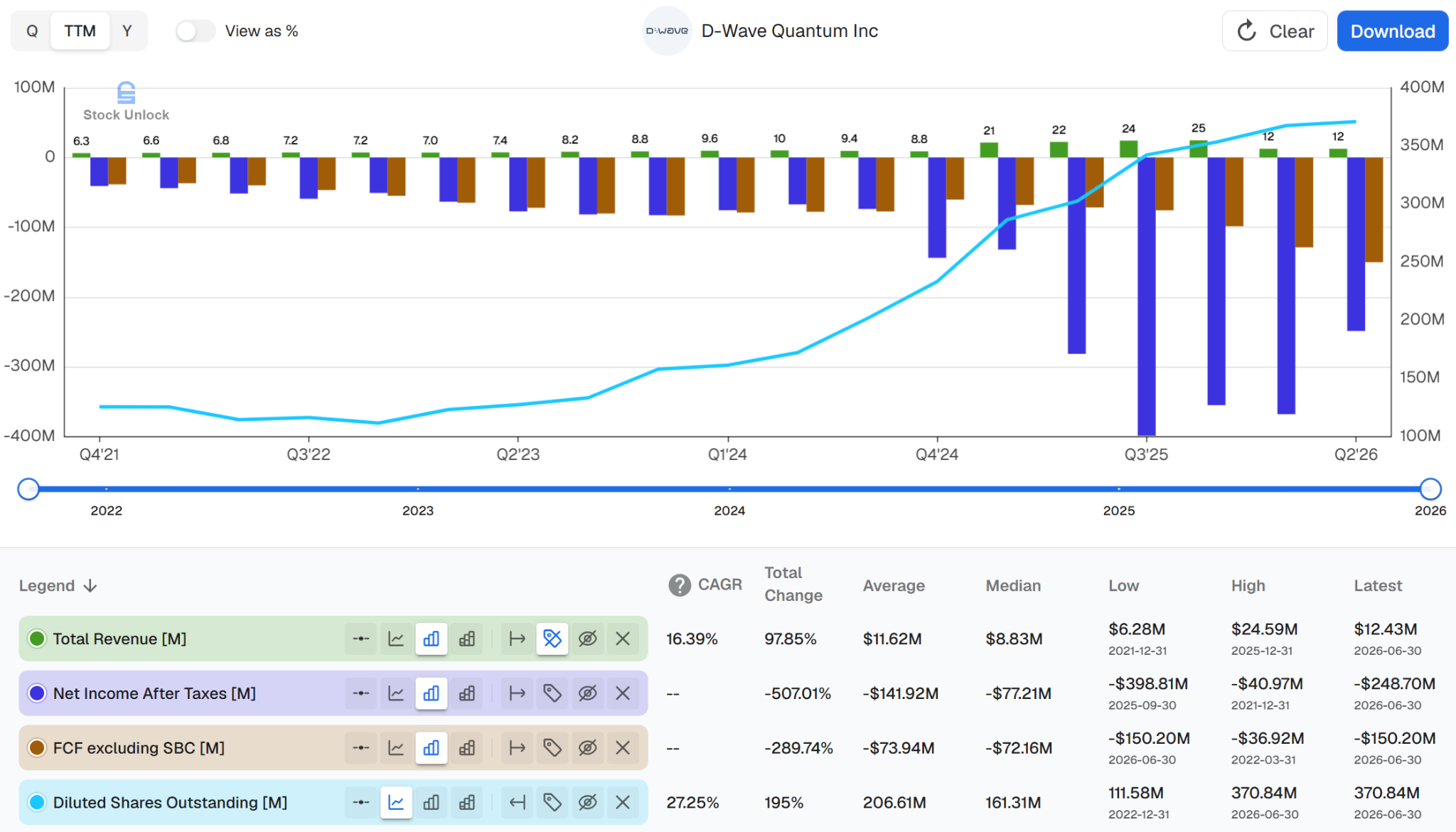
Revenue trend: Revenue never managed to keep growing, and the stock keeps diluting. Very reassuring.
External Views
2025-01-18 WSM video: "Quantum Value" Debunked
- QBTS claims its quantum computers are “already useful today”. It has plenty of big customers, like Mastercard, using them. But if that were really the case, why is revenue still only this pitiful sliver? The big companies are most likely just experimenting, and have not found a real use for it.
2025-03-16 BBM video: Quantum Stocks Are Pumping Again. It's Even Dumber Than Last Time.
- QBTS's “quantum supremacy” claims.
2025-05-22 BBM video: Don't Be Fooled By D-Wave's Q1 Revenue Growth $QBTS
- Jülich Supercomputing Centre deal, a German research institute. 13M.
- Quantum computing solutions have not yet produced real commercial value. We agree with that.
- - - -
- Our check: We plan to do a separate piece of research, looking for whether anything has been published online about this Jülich institute since.
- It went from a hosted/partnership deployment to Jülich formally owning it. It is not that D-Wave suddenly sold a completely new additional system.
- Looking at it neutrally, without letting emotion take over: at least three papers have been published on the back of that system, which is actually a point in favor of the technology's credibility.
2025-05-30 Reddit WSB: Quantum Scamming Inc: The Big Short Nobody Saw Coming
- A fairly ordinary analysis. He is short QUBT and QBTS. There is one point of his we agree with: even if quantum really does produce a huge breakthrough, the winners will most likely still only be the quantum divisions of the giants like IBM, GOOG and MSFT.
2025-08-16 WSM video: Quantum Blockchain, Wall Street's Latest Scam
- The QBTS CEO floated the concept of a quantum cryptocurrency. That is a bit absurd. This really is just fleecing the gullible.
- Hybrid computing is the only part of these partnerships that produces any useful data at all, but exactly how the hybrid is hybrid is a very interesting question. | Former D-Wave Engineer: If I had to bet, I would say almost entirely the classical system.
- How do I know it's not just a GPU sitting in a big fancy box with D-Wave written on the side? And they never gave us a suitable answer.
Learning How Quantum Computing Works
2014-08-24 P vs. NP and the Computational Complexity Zoo - hackerdashery
- P = can be solved quickly
- NP = can be verified quickly, like sudoku or protein folding
- NP-complete = the hardest class of problems inside NP
- Quantum computing only gives us a completely new angle on handling problems of different complexity in the computing field.
2023-12-17 I made a (useless) quantum computer at home - Looking Glass Universe
- State preparation -> computation -> measurement
- Qubit
2023-12-22 What can my homemade quantum computer do? - Looking Glass Universe
- A quantum computer is not an all-purpose "supercomputer". Its advantage is that specific algorithms (such as Deutsch-Jozsa) may behave differently from a classical computer on certain specific problems
- Deutsch-Jozsa demonstration: the video introduces the algorithm through a "black box" puzzle, namely how to tell in a single computation whether a function is "balanced" or "constant"
- Useful. It finally got concrete. But an ordinary computer also halves the range in one shot. So the quantum advantage here is only that it narrows the range by half in a different way. That does not really count as an advantage.
2025-04-30 But what is quantum computing? (Grover's Algorithm) - 3Blue1Brown
- 🟢 This one is good. The quality of the explanation is much higher. It earns its place as one of our favorite science channels.
- |ket>, 2^k possible output = k qubit, you only see the observation
- How Grover's algorithm works: it finds a specific target among N unsorted options. It uses the interference principle of quantum mechanics, repeatedly applying a "sign flip" and a "reflection about the mean" so that probability density gradually concentrates on the target solution, which gives a square-root speedup over classical brute-force search.
- The author did not explain the oracle well enough, which left us not understanding parts of it. We got it after some extra research.
2025-05-04 Where my explanation of Grover’s algorithm failed - 3Blue1Brown
- sqrtN is still meaningless for every real-world problem we have today.
2025-06-27 Why I Left Quantum Computing Research - Looking Glass Universe
- Cambridge, quantum computing, applied math PhD.
- The hardware side is going well. The software side is not.
- Encryption: Shor's factoring algorithm 1994.
- Chemistry: “We conclude that evidence for such an exponential advantage across chemical space has yet to be found.” # This is scientists' way of saying no.
- Simulation / Material: Materials science, for example room-temperature superconductors.
- Our view: For the quantum field to truly take off, the condition is not just a mature quantum computer. A mature mechanism for developing quantum algorithms has to appear too.
Company-Specific Analysis and Research
- QBTS CEO Alan Baratz.
- A lot of what he says makes no sense at all. Quantum cryptocurrency, quantum AI. Does he know how absurd the things he is saying are? He has a real research PhD background, so he should. Then it is not stupidity, it is bad faith.
Technology route: Quantum annealing (good at optimization problems) + gate model (general-purpose quantum computing) + hybrid systems.
- Gate model: They later announced a move into gate-model development by acquiring another company. We do not think this company has the ability or the resources to do frontier general-purpose quantum chip development. | Google, IBM and Microsoft are the current leaders in this field.
- Quantum computing overall: We think the public has a misconception right now. Quantum computing is not the next generation of computer, and it will not replace the classical computing systems we already have. It is an entirely new system, and it fits better on certain specific problems, because some real-world problems simply match quantum states more closely. But we think that class of problems will be very niche and low-frequency. 1 - We are still very far from a mature, usable commercial product, maybe another ~20 years. 2 - Even once a mature product exists, the market that needs it is very small. 3 - On the evidence so far, QBTS has neither the ability nor any attempt underway to do frontier research in the quantum field.
Stock community:
- Seeking Alpha comments
- r/QBTSstock: Very naive and sweet. Most of the longs do not understand quantum computing at all, they hate the shorts, and most of what they post runs on emotion.
Current view: We think we are at least 20 years away from a genuinely usable quantum computing product that solves real-world problems. And its market will be far smaller than the public currently believes. Quantum computing is not a new generation of the classical computer. It will not and cannot replace the classical computers we already have. It only holds an edge on a small subset of specific problems, where its nature is a closer fit. QBTS as a company does not have the ability, and is not even trying, to do frontier research and development in quantum computing. Progress in this field will most likely be led by the quantum divisions of the giants like Google, IBM and Microsoft, and by government-backed research institutes. We think this company is close to taking investors' money under false pretenses. There is no value here, and management probably knows it. There is room to profit from a short.
Working title: Quantum computing will not replace classical computing.
Danger signals: # Signals that should make us re-examine our view and the risks.
- Quantum computing solves, comes close to solving, or shows the possibility of coming close to solving, a problem the real world genuinely needs solved.
- A mature system for developing quantum algorithms appears.
Current decision: Holding the -4.60% position. If there is a big run-up later, we can consider adding to it.
Considering Adding
Price change: Down 61.74% from the October 2025 high.
Synthetic short:
| SS Calculation | QBTS | |
|---|---|---|
| Expiration | 2029-01-19 | |
| Time to Expiration - Years | 2.32 | |
| Strike | 17.00 | |
| Current Share Price | 17.90 | |
| Credit - Worst | 1.85 | |
| Credit - Actual | 2.33 | |
| Credit - Best | 2.80 | |
| Annual Rate - Worst, Fee Only | 2.47% | |
| Annual Rate - Actual, Fee Only | 3.81% | |
| Annual Rate - Best, Fee Only | 5.20% | |
| Total Cost - Round-Trip Commissions | 0.15% | |
| Total Cost - Round-Trip Spread | 5.31% | # Too high. This time we will just short the stock outright. |
Current decision: Increasing the short from -4.67% to -6%. One of our only two core go-to-zero shorts right now. Very confident in the call. If there is a big run-up later, we will lean toward adding more.
| Date | Ticker | Action | Shares | Total | Execution Price | Weight Before | Weight After |
|---|---|---|---|---|---|---|---|
| 2026-09-25 | QBTS | Short | -1,234.00 | 21,579.0 | 17.49 | -4.66% | -6.00% |
Current Position:
| Ticker | Total Shares | Average Cost | Current Price | Gain | Return | Exposure | Weight |
|---|---|---|---|---|---|---|---|
| QBTS | -5,534.00 | 23.88 | 17.46 | 35,508.36 | 26.87% | -96,623.64 | -6.00% |