Contents
Key Summary
2026-08-06 Current View: We think the biggest problem in deep-sea mining is not getting a legal permit, but the technology and commercial cost. At this stage and for the short-to-medium-term future, we think deep-sea mining will have a hard time becoming a profitable commercial operation. The recent hype around TMC has mostly focused on permits. So the huge share-price rise this caused has, in our view, created room to profit from a short.
2026-09-28 Current decision: Increasing the short from -3.17% to -6%. One of our only two core go-to-zero shorts right now. Very confident in the call. If there is a big run-up later, we will lean toward adding more.
| Date | Ticker | Action | Shares | Total | Execution Price | Weight Before | Weight After |
|---|---|---|---|---|---|---|---|
| 2026-09-28 | TMC | Short | -11,871.00 | 45,196.7 | 3.81 | -3.16% | -5.98% |
2026-09-28 Current Position:
| Ticker | Total Shares | Average Cost | Current Price | Gain | Return | Exposure | Weight |
|---|---|---|---|---|---|---|---|
| TMC | -25,188.00 | 5.18 | 3.86 | 33,171.95 | 25.44% | -97,225.68 | -6.06% |
2026-09-28 Trade Record:
| Date | Ticker | Action | Shares | Total | Execution Price | Weight Before | Weight After |
|---|---|---|---|---|---|---|---|
| 2025-07-08 | TMC | Short | -1,200.00 | 7,818.36 | 6.52 | ||
| 2025-07-17 | TMC | Short | -600.00 | 4,752.90 | 7.92 | ||
| 2025-10-07 | TMC | Short | -929.00 | 8,751.18 | 9.42 | ||
| 2026-01-14 | TMC | Short | -1,257.00 | 9,980.71 | 7.94 | ||
| 2026-01-22 | TMC | Short | -1,327.00 | 12,009.35 | 9.05 | ||
| 2026-02-19 | TMC | Short | -900.00 | 5,409.00 | 6.01 | ||
| 2026-02-19 | TMC | Short | -100.00 | 601.00 | 6.01 | ||
| 2026-02-26 | TMC | Short | -1,488.00 | 9,761.28 | 6.56 | ||
| 2026-06-09 | TMC | Short | -1,454.00 | 7,269.85 | 5.00 | -2.94% | -3.49% |
| 2026-08-07 | TMC | Short | -4,062.00 | 18,847.29 | 4.64 | -2.78% | -3.99% |
| 2026-09-28 | TMC | Short | -11,871.00 | 45,196.7 | 3.81 | -3.16% | -5.98% |
2026-08-06 Technology route: Deep-sea mining.
- Compared with deep-sea mining, deepwater oil is already mature. Deepwater oil costs much more than onshore oil.
- Compared with deepwater oil, deep-sea mining has many extra problems: 1 - These polymetallic nodules are scattered across the seabed, so you have to keep moving to collect them. One means putting a pipe in one place and continuously sucking; the other means using mobile machinery to collect them one by one. The complexity and cost are much higher. 2 - Then you have to move them from the seabed to the surface. High-density solid minerals are a lot harder than liquid petroleum. 3 - Finally, the impurity level of what you are collecting is also very different. Ore is much higher.
- Taking one step back, even if deep-sea mining is technically workable—they still do not have enough investment to pull it off. And even if it can be commercialized—which we think is extremely unlikely—this company also does not have much of a moat. Everything they do—shipbuilding, extraction, processing—is outsourced.
- International permit vs. U.S. permit. A lot of people focus on the permit, but we feel that technology and commercial cost are the hardest barriers to get over. | Nautilus did it inside Papua New Guinea's exclusive economic zone before, which solved the permit problem, and still failed.
2026-08-06 Danger signals: # Signals that should make us re-examine our view and the risks.
- TMC makes substantive progress toward commercial-scale production.
- TMC secures major financing, or a strategic partnership, sufficient to complete commercial-scale production.
Complete Notes
Created the Note
Note: Our old notes were more stream-of-consciousness. The point was to record and review fast. We are redesigning a standardized framework for recording and publishing investment notes.
Trade Record:
| Date | Ticker | Action | Shares | Total | Execution Price | Weight Before | Weight After |
|---|---|---|---|---|---|---|---|
| 2025-07-08 | TMC | Short | -1,200.00 | 7,818.36 | 6.52 | ||
| 2025-07-17 | TMC | Short | -600.00 | 4,752.90 | 7.92 | ||
| 2025-10-07 | TMC | Short | -929.00 | 8,751.18 | 9.42 | ||
| 2026-01-14 | TMC | Short | -1,257.00 | 9,980.71 | 7.94 | ||
| 2026-01-22 | TMC | Short | -1,327.00 | 12,009.35 | 9.05 | ||
| 2026-02-19 | TMC | Short | -900.00 | 5,409.00 | 6.01 | ||
| 2026-02-19 | TMC | Short | -100.00 | 601.00 | 6.01 | ||
| 2026-02-26 | TMC | Short | -1,488.00 | 9,761.28 | 6.56 | ||
| 2026-06-09 | TMC | Short | -1,454.00 | 7,269.85 | 5.00 | -2.94% | -3.49% |
Current Position:
| Ticker | Total Shares | Average Cost | Current Price | Gain | Return | Exposure | Weight |
|---|---|---|---|---|---|---|---|
| TMC | -9,255.00 | 7.17 | 4.12 | 28,223.03 | 42.53% | -38,130.60 | -2.46% |
Data Analysis:
| Ticker | TMC | |
| Next Earnings | 08-17 | |
| Share Price | 4.12 | |
| Diluted Shares | 425.77 M | |
| Market Cap | 1.75 B | # Not especially big, but at least clearly above 1B. |
| Revenue | 0.00 M | |
| Earning | -319.9 M | |
| PS | INF | # They are not even pretending. Though honestly, there is not much to pretend about. |
| PE | -5.48 | # Losing money at a pretty good speed. |
| Cash | 119.68 M | |
| FCF (-SBC) | -144.6 M | |
| Cash Runway | 0.83 | # Less than one year. This could be a crash catalyst. |
| PFCF | -12.13 | |
| Dilution 3Y | 12.33% | |
| Dilution 1Y | 23.31% | # Surprisingly, the dilution has been fairly restrained. |
| Short Float % | 14.11% | |
| Days to Cover | 5.17 | # Float is not high, but the days are not low. Looks like volume is light. |
| Borrow Fee | 0.43% | |
| Reasonable Market Cap | 139.7 M | # Total tangible assets. |
| Profit Potential | 92.03% | |
| Loss Intensity | -9.12% | # Pretty good. |
| Confidence It Is Not Viable 0-10 | 9 | # We are very confident that deep-sea mining will have a hard time commercializing. Honestly, we could give it a 10. |
| Has Crash Catalyst 0-10 | 7 | # 0.83 years of cash. |
| No Short-Squeeze Risk 0-10 | 7 | # Actually fairly low, but light trading volume pushes DTC to five days. |
External Views
2025-07-04 WSM video: Deep Sea Mining: Wall Street's Latest Scam
- International permit vs. U.S. permit. International Seabed Authority—the U.S. is not in it.
- Management's previous deep-sea mining company: Nautilus Minerals. Bankrupt in 2019. Total financing raised: $0.7B.
- Nautilus worked closely with Papua New Guinea and could mine inside its exclusive economic zone. The government directly invested $0.12B.
- Our view: But it still failed. That shows the permit was not the problem; technology and cost were. Now the new company is putting the focus back on permits again, which makes the motive worth questioning. | To be fair, Nautilus and TMC's projects are not completely the same. Nautilus planned to cut seafloor massive sulfides in Papua New Guinea waters; TMC plans to collect polymetallic nodules from deeper international seabed.
- TMC was previously called DeepGreen. It changed its name to TMC during the SPAC deal.
- TMC CEO Gerard Barron was an early Nautilus Minerals investor. His main background is entrepreneurship, investing, and advertising, not mining engineering. Nautilus went bankrupt, but he got out near the top and made a lot of money. A $226,000 early investment ultimately turned into $31M cashed out.
- The company itself = Canadian. Processing = outsourced to Japan's PAMCO. Operations = outsourced to Dutch company Allseas.
- Developments after the video:
- 2025-08: Published a pre-feasibility study.
- 2026-05: The Allseas contract officially became binding, with commissioning targeted for Q4 2027.
2025-08-18 Iceberg Research's 6 short reports
- A replay of Nautilus Minerals: the same deep-sea mining story, pushed by the same Gerard Barron group.
- What the U.S. is really dependent on China for is processing and rare-earth magnets, not TMC's ores.
- TMC's key partners—Allseas, PAMCO, Korea Zinc, Glencore, and others—are all inside the UNCLOS treaty system.
Company-Specific Analysis and Research
Technology route: Deep-sea mining.
- Compared with deep-sea mining, deepwater oil is already mature. Deepwater oil costs much more than onshore oil.
- Compared with deepwater oil, deep-sea mining has many extra problems: 1 - These polymetallic nodules are scattered across the seabed, so you have to keep moving to collect them. One means putting a pipe in one place and continuously sucking; the other means using mobile machinery to collect them one by one. The complexity and cost are much higher. 2 - Then you have to move them from the seabed to the surface. High-density solid minerals are a lot harder than liquid petroleum. 3 - Finally, the impurity level of what you are collecting is also very different. Ore is much higher.
- Taking one step back, even if deep-sea mining is technically workable—they still do not have enough investment to pull it off. And even if it can be commercialized—which we think is extremely unlikely—this company also does not have much of a moat. Everything they do—shipbuilding, extraction, processing—is outsourced.
- International permit vs. U.S. permit. A lot of people focus on the permit, but we feel that technology and commercial cost are the hardest barriers to get over. | Nautilus did it inside Papua New Guinea's exclusive economic zone before, which solved the permit problem, and still failed.
Current management: They already did a deep-sea mining company before. It collapsed and went bankrupt, but management and early investors still made a lot of money.
- Gerard Barron, CEO + Chairman: An early Nautilus investor who later took direct control of the company. He cashed out near the top before Nautilus went bankrupt. A $226,000 early investment ultimately turned into $31M cashed out.
- Anthony O'Sullivan, Chief Development Officer: Former Nautilus COO.
History of the commercial timeline: In 2021 they said initial commercial production in 2024; in 2022/2023 it became late 2024/early 2025; after 2023 it became Q4 2025; in 2024 they paused CAPEX while waiting for regulatory clarity; in 2025/2026 they switched to the U.S. NOAA route. The current line is a permit before Q1 2027 and commissioning in Q4 2027. The timeline keeps moving to the right.
Total financing raised: Nautilus Minerals raised about $0.69B before bankruptcy. | TMC has raised about $0.53B so far.
Stock community:
Current View: We think the biggest problem in deep-sea mining is not getting a legal permit, but the technology and commercial cost. At this stage and for the short-to-medium-term future, we think deep-sea mining will have a hard time becoming a profitable commercial operation. The recent hype around TMC has mostly focused on permits. So the huge share-price rise this caused has, in our view, created room to profit from a short.
Working title: The core problem with deep-sea mining is not the permit, but the technology and commercial cost.
Danger signals: # Signals that should make us re-examine our view and the risks.
- TMC makes substantive progress toward commercial-scale production.
- TMC secures major financing, or a strategic partnership, sufficient to complete commercial-scale production.
News: Reports Say TMC Will Attend Trump's Critical-Minerals Roundtable
Share-price move: It rose 13% today and is up 36% from the monthly low.
Current decision: Increase the current position from -2.78% to -4.00%. If permit news keeps pushing the share price higher, we plan to keep adding.
| Date | Ticker | Action | Shares | Total | Execution Price | Weight Before | Weight After |
|---|---|---|---|---|---|---|---|
| 2026-08-07 | TMC | Short | -4,062.00 | 18,847.29 | 4.64 | -2.78% | -3.99% |
Current Position:
| Ticker | Total Shares | Average Cost | Current Price | Gain | Return | Exposure | Weight |
|---|---|---|---|---|---|---|---|
| TMC | -13,317.00 | 6.40 | 4.63 | 23,543.21 | 27.63% | -61,657.71 | -3.98% |
Q2 Earnings Released
Data Analysis:
| Ticker | TMC | TMC | |
| Next Earnings | 08-17 | 11-10 | |
| Share Price | 4.12 | 4.54 | |
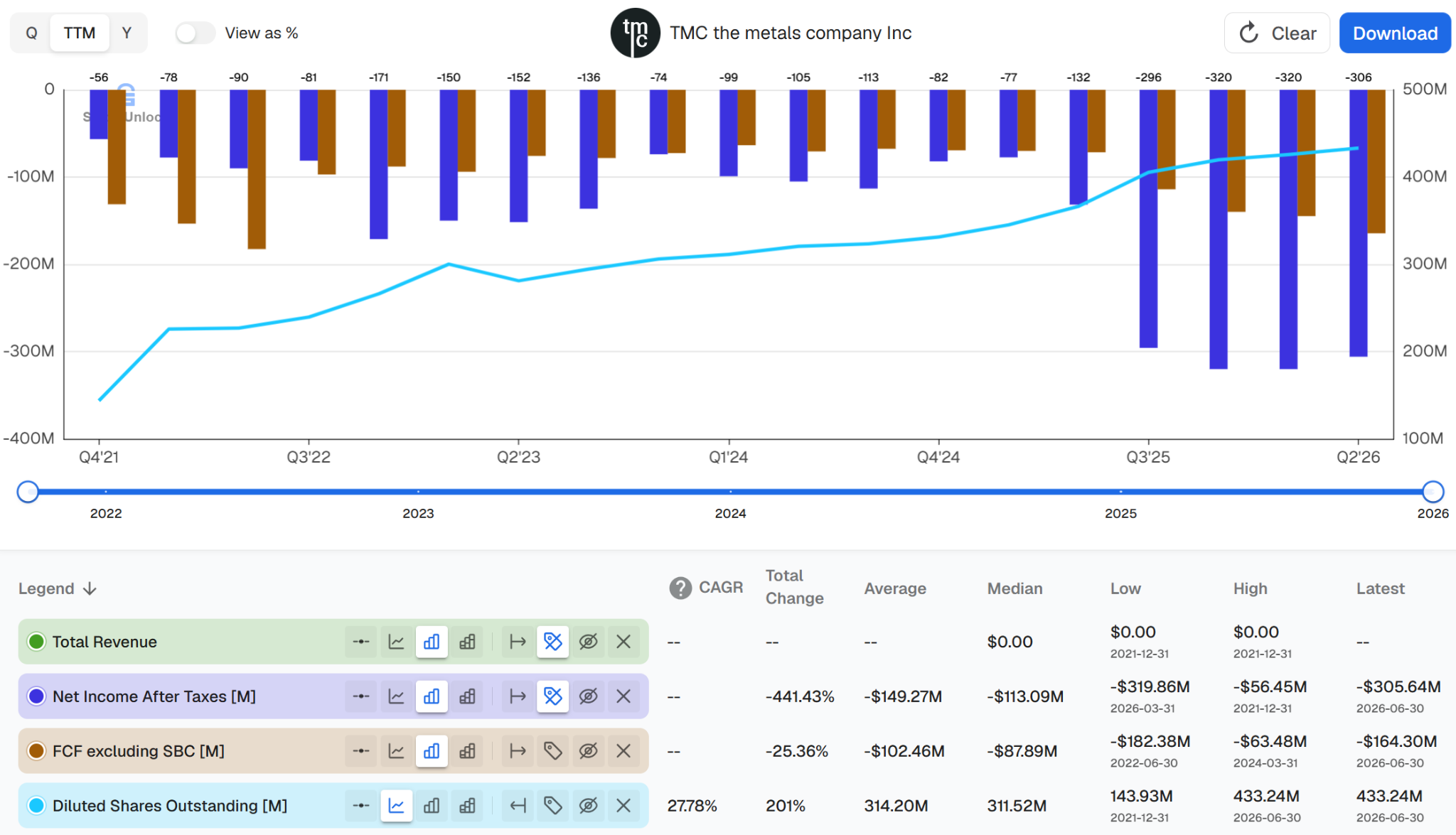
| Diluted Shares | 425.77 M | 433.24 M | |
| Market Cap | 1.75 B | 1.97 B | # Not especially big, but at least clearly above 1B. |
| Revenue | 0.00 M | 0.00 M | |
| Earning | -319.9 M | -305.6 M | |
| PS | INF | INF | # They are not even pretending. Though honestly, there is not much to pretend about. |
| PE | -5.48 | -6.44 | # Losing money at a pretty good speed. |
| Cash | 119.68 M | 98.66 M | |
| FCF (-SBC) | -144.6 M | -164.3 M | |
| Cash Runway | 0.83 | 0.60 | # Some deterioration has shown up here. |
| PFCF | -12.13 | -11.97 | |
| Dilution 3Y | 12.33% | 15.06% | |
| Dilution 1Y | 23.31% | 9.26% | # Surprisingly, the dilution has been very restrained. |
| Short Float % | 14.11% | 12.94% | |
| Days to Cover | 5.17 | 5.19 | # Float is not high, but the days are not low. Volume is light. |
| Borrow Fee | 0.43% | 0.68% | |
| Reasonable Market Cap | 139.7 M | 135.6 M | # Total tangible assets. |
| Profit Potential | 92.03% | 93.10% | |
| Loss Intensity | -9.12% | -7.77% | # Good enough. |
| Confidence It Is Not Viable 0-10 | 9 | 9 | # We are very confident that deep-sea mining will have a hard time commercializing. We could give it a 10. |
| Has Crash Catalyst 0-10 | 7 | 7 | # 0.6 years of cash. |
| No Short-Squeeze Risk 0-10 | 7 | 5 | # The risk that a government stake drives a sharp price rise and triggers a squeeze is real. |
Earnings Call Notes:
- The company formally admitted that the previously expected Q1 2027 permit timing is no longer likely.
- Of the roughly $3B of investment announced at the August 7 Trump critical-minerals roundtable, not one item was explicitly directed at TMC or at nodule mining.
Revenue Trend:
Considering Adding
Price change: Down 64.22% from the October 2025 peak.
Current decision: Increasing the short from -3.17% to -6%. One of our only two core go-to-zero shorts right now. Very confident in the call. If there is a big run-up later, we will lean toward adding more.
| Date | Ticker | Action | Shares | Total | Execution Price | Weight Before | Weight After |
|---|---|---|---|---|---|---|---|
| 2026-09-28 | TMC | Short | -11,871.00 | 45,196.7 | 3.81 | -3.16% | -5.98% |
Current Position:
| Ticker | Total Shares | Average Cost | Current Price | Gain | Return | Exposure | Weight |
|---|---|---|---|---|---|---|---|
| TMC | -25,188.00 | 5.18 | 3.86 | 33,171.95 | 25.44% | -97,225.68 | -6.06% |